
Hybrid Cloud Security: Protecting Data Across On-Prem and Cloud Environments
Hybrid cloud security means one policy set across on-prem and cloud, not two. See the risks, best practices, and how Logically closes the visibility gap.
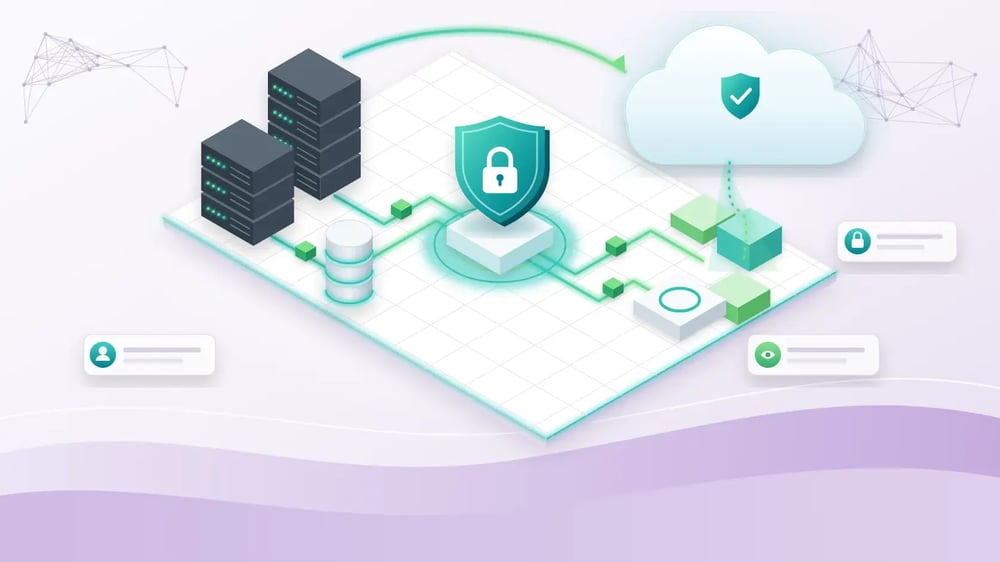
Hybrid Cloud Security: Protecting Data Across On-Prem and Cloud Environments
Key Takeaways
- Hybrid cloud security applies one consistent set of security policies across on-premises infrastructure and public cloud environments, not two separate approaches managed by two separate teams.
- The majority of mid-market organizations now run infrastructure that spans internal systems and at least one public cloud platform, and that mix is becoming the default rather than a temporary stop on the way to full cloud adoption.
- Four risk areas account for most hybrid cloud security problems: data in transit between environments, identity and access sprawl, shadow IT and unsanctioned cloud use, and backup or disaster recovery gaps that only surface during an actual incident.
- The organizations that manage hybrid cloud environments well usually aren't running more tools than everyone else, they're running one policy set across every environment instead of a different one for on-prem and cloud.
On This Page
What Is Hybrid Cloud Security?
A hybrid cloud environment combines on-premises infrastructure, whether that's a traditional data center or in-house servers, with one or more public cloud platforms like AWS or Microsoft Azure, connected under a shared architecture. That's different from multi-cloud, which describes using more than one public cloud provider, regardless of whether any on-prem systems are involved at all. An organization can run hybrid cloud environments and a multi-cloud environment at the same time: internal systems connected to more than one public cloud platform, for example, and most large hybrid cloud environments end up looking exactly like that. Whether a given workload is delivered as infrastructure-as-a-service (IaaS) or through a more specific platform-level service, the same hybrid cloud security expectations should apply.
Hybrid Cloud vs. Multi-Cloud
| Hybrid Cloud | Multi-Cloud | |
|---|---|---|
| What It Combines | On-premises infrastructure plus one or more cloud environments, public or private | More than one public cloud provider |
| On-Prem Systems Involved | Yes | Not required |
| Can Overlap With the Other | Yes, when internal systems connect to more than one public cloud | Yes, when the mix also includes on-prem systems |
Hybrid cloud security is the practice of extending consistent protection, visibility, and policy enforcement across that entire mix, instead of treating on-prem systems and the public cloud as two separate security problems. The technology stack looks different in each environment: network security tools like firewalls, VPNs, and network segmentation on the internal side, identity and access management (IAM) and API security on the cloud side, but the security posture behind all of it needs to hold together as one system. When it doesn't, gaps open up right where internal infrastructure and cloud platforms meet, and that's what separates a well-designed hybrid cloud architecture from one that just grew that way over time.
Multi-cloud environments raise a related but distinct question. Multi-cloud security overlaps heavily with hybrid cloud security in practice: consistent policy, consistent visibility, and one identity system instead of several, whether the mix in question is two public clouds or a public cloud paired with a legacy on-prem environment.
Why Hybrid Cloud Environments Are Harder to Secure
Misconfigurations are consistently one of the leading causes of cloud data breaches, and hybrid cloud environments make misconfiguration more likely, not less. Human error is usually the actual cause behind the statistic, a policy that never made it from the on-prem side to the cloud side, or a storage bucket left open during a migration, not a sophisticated attack. Every additional environment, whether that's a private cloud instance, a public cloud services account, or an internal infrastructure component, is another place a security policy can be applied inconsistently or forgotten entirely.
Visibility is the first problem. Internal systems and public cloud platforms are typically monitored by different tools built for different environments, so a security team can end up with a clear view of one half of the environment and a blind spot in the other. Security policies that get updated on the cloud side don't always make it back to the on-prem side, or the reverse, so the same organization ends up enforcing two different standards for access management, patching, and monitoring depending on where a given workload happens to live.
Compliance adds another layer. Regulatory compliance requirements like HIPAA or GDPR don't care which environment data sits in; they apply the moment sensitive data crosses from an internal system into a public cloud platform, or from one cloud service provider to another. An organization can be fully compliant in each environment individually and still have a compliance gap at the seam between them, which is often exactly where a security posture review finds the biggest surprises.
None of these security challenges are unique to any one platform or provider; they show up whenever two environments have to operate as one.
Core Hybrid Cloud Security Risks
Most incidents in hybrid cloud environments trace back to one of four risk areas.
- Data in Transit: Data moving between internal systems and public cloud environments, or between two cloud service providers, passes through more network hops than data that stays in a single environment. Without data encryption enforced consistently at every hop, that movement becomes an attack surface hybrid cloud environments have and single-environment setups don't.
- Identity and Access Sprawl: Internal identity systems and cloud IAM platforms don't always sync cleanly, so access controls can drift in one environment without anyone noticing in the other. A former employee's on-prem account might get disabled the same day, while a cloud services account tied to the same identity stays active for weeks. MFA and centralized identity management close most of that gap, but only if they're enforced everywhere, not just wherever security reviews look most closely.
- Shadow IT and Unsanctioned Cloud Use: Hybrid cloud environments make it easy for a team to spin up a new SaaS tool or a public cloud account without looping in IT or security, especially when the existing approval process feels slower than signing up directly. Every one of those unsanctioned accounts is infrastructure nobody is monitoring, patching, or including in an incident response plan.
- Backup and Disaster Recovery Gaps: A backup strategy built for internal infrastructure doesn't automatically extend to cloud workloads, and the reverse is just as common: cloud-native backup tools that don't cover an on-prem system still running critical applications. Business continuity planning has to account for both sides failing independently, not just one at a time.
Hybrid Cloud Security Best Practices
The organizations that get hybrid cloud security right tend to follow the same handful of practices.
- Unify visibility across environments: Bring internal infrastructure and every public cloud platform into a single monitoring view, whether that's a SIEM or another centralized security operations tool, so a team is looking at one picture instead of stitching together several.
- Standardize policy and configuration management: Apply the same security policies, whether that governs firewalls, network segmentation, or access controls, across on-prem systems and public cloud environments alike, so a workload's protection doesn't change just because it moved.
- Encrypt data at rest and in transit: Data encryption and current SSL standards are the foundation of data security, and should apply everywhere data lives or moves, from an internal data center to a public cloud services account, with data privacy and data protection requirements like GDPR or HIPAA treated as a floor, not a target.
- Apply role-based access control consistently: IAM, multi-factor authentication, and access policies should follow the same rules whether an employee is logging into an internal system or a cloud application, ideally through one centralized identity management platform and zero trust principles that verify every request instead of trusting anything inside the network perimeter by default.
- Automate configuration enforcement: Manual configuration checks don't scale across a hybrid cloud environment, and misconfigurations are one of the most common ways unauthorized access happens in the first place. Automated tools, including cloud-native application protection platforms (CNAPP), catch configuration drift faster than a periodic manual review can, whether the workload in question involves virtual machines, a set of APIs, or Kubernetes-orchestrated containers.
- Monitor continuously across environments: Endpoint security matters as much in a hybrid cloud environment as network security does: a compromised on-prem endpoint can reach cloud systems just as easily as the reverse. Continuous monitoring, ideally supported by machine learning-based anomaly detection, is what catches lateral movement and unauthorized activity before minor anomalies turn into real security threats and full-blown cyberattacks, rather than after a scheduled audit finds them weeks later. Ransomware and malware in particular tend to move fast once they land.
- Plan backup and disaster recovery for both sides: Business continuity plans should assume internal infrastructure and cloud environments can each fail independently, and should be tested against both scenarios, not just the one that seems more likely.
How Logically Approaches Hybrid Cloud Security
Every hybrid cloud architecture looks a little different depending on what's driving it: compliance, latency, or legacy investment. But the security strategy behind a given hybrid cloud model shouldn't vary as much as the architecture does. The strongest hybrid cloud security solutions are the ones built into the hybrid cloud strategy from the start, not layered on after the infrastructure decisions are already made, which is as true for a fast-moving digital transformation project as it is for an environment that's stayed mostly static for years.
Logically's Hybrid Cloud Integration service connects internal infrastructure and cloud environments into one accountable operating model, so IT infrastructure that spans a data center, a private cloud, and public cloud platforms like AWS or Microsoft Azure gets managed under a single set of standards rather than a different playbook for each environment.
That approach is built on the same cyber-first approach to security Logically applies across its cybersecurity services generally: security, IAM, and compliance considerations get built into infrastructure design and management from the start, rather than added after a migration is already finished. For a hybrid cloud environment specifically, that means the same team managing internal systems and public cloud platforms is also responsible for security posture across both, not a separate security vendor brought in after the infrastructure decisions are already made.
That combined model is the practical difference for organizations weighing zero trust adoption or trying to close identity gaps between internal and cloud systems. One team with visibility into both environments can catch identity drift, misconfigurations, or a suspicious access pattern before it spreads, rather than after someone happens to notice it during an unrelated review.
Hybrid cloud security isn't a checklist item to complete once and move on from, it's an ongoing discipline that has to keep pace as infrastructure changes. Logically's managed cloud services bring internal infrastructure and cloud environments under one accountable, cyber-first operating model, so security policy doesn't depend on which environment a workload happens to be running in today.