What Managed Security Services Include and How to Choose a Provider
Managed security services bundle 24/7 SOC monitoring, threat detection, and incident response. See what's typically included and how to choose a provider.
What Managed Security Services Include and How to Choose a Provider
Managed security services are outsourced cybersecurity services that monitor your environment, detect threats, investigate suspicious activity, and respond on your behalf. What a provider includes varies by provider and plan, so the label alone doesn't tell you much. When you compare providers, three details matter most: what gets monitored, when it gets monitored, and whether the provider acts on a threat or only sends an alert.
Key Takeaways
- Managed security services commonly include continuous monitoring, threat detection, investigation, and response, delivered by an outside provider.
- What's included varies by provider and plan, so compare the actual list of monitored systems and services rather than the label.
- Before signing, confirm what the provider monitors, whether coverage runs 24/7 or only during business hours, and whether the provider acts on threats or only sends alerts.
- How a provider connects security with IT operations affects accountability and response, because the handoff between separate vendors is where gaps tend to open.
- Skills are a pressure point for security teams: in ISC2's 2025 Cybersecurity Workforce Study, 95% of the 16,029 cybersecurity professionals surveyed reported at least one skill need.
On This Page
- 1What Are Managed Security Services?
- 2What's Included in Managed Security Services?
- 3How Much Do Managed Security Services Cost?
- 4Signs Your Organization Needs Managed Security Services
- 5How to Choose a Managed Security Services Provider
- 6How Logically's Managed Security Services Work
- 7Frequently Asked Questions
What Are Managed Security Services?
A managed security service provider, or MSSP, delivers an outsourced, ongoing service that monitors an environment for cyber threats, detects them, and responds on an organization's behalf. That's a narrower category than managed service providers broadly. MSPs generally focus on keeping IT operations running day to day and providing baseline IT security, while an MSSP is built specifically around cybersecurity: detection, threat intelligence, and response.
A related term is managed detection and response, or MDR. MDR describes the specific service of detecting threats and responding to them, usually through a combination of security technologies and human analysts. It's often one component of what a broader MSSP delivers rather than a separate category. Extended detection and response, or XDR, is the platform that correlates signals across endpoints, networks, and cloud security tools. Managed XDR, or MXDR, adds provider-managed detection on top of it.
In practice, most buyers care less about the acronyms than about one question. Are IT and security handled by one team, or handed off between an MSP and a separate MSSP?
What's Included in Managed Security Services?
A managed security services package generally bundles several disciplines that used to be sold separately.
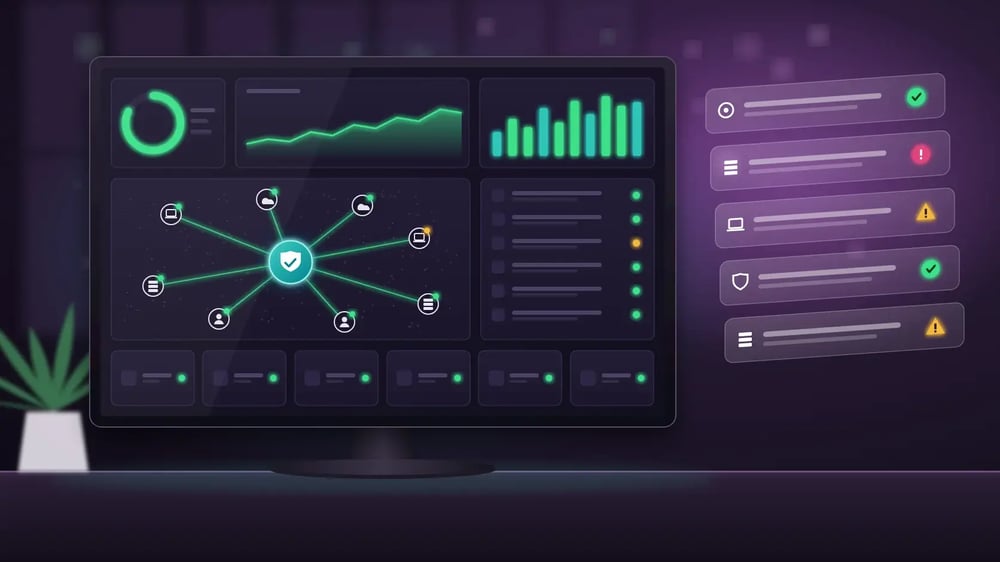
- 24/7 Security Operations Center Monitoring: A security operations center, or SOC, staffed around the clock rather than during business hours only, so detection doesn't stop when the internal team logs off. SIEM tooling, sometimes delivered as managed SIEM, usually feeds it the data needed for continuous monitoring.
- Endpoint Detection and Response: EDR detects and responds to threats on individual devices, the layer where many cyberattacks and malware infections start.
- Threat Intelligence and Dark Web Monitoring: Tracks known threat actors, leaked credentials, and emerging attack patterns so a provider can act before an exposure turns into a data breach. Some providers add proactive threat hunting.
- Vulnerability Management: Ongoing vulnerability scanning, penetration testing, patch management, and remediation guidance, so new exposures get caught as an environment changes.
- Identity, Email, and Cloud Security: Reduces the human side of cyber risk, including phishing, credential theft, and account compromise, and extends data protection standards to software as a service tools and cloud environments.
- Incident Response: A documented plan and dedicated team ready to contain and remediate a security incident when detection alone isn't enough.
Logically maps these disciplines to three service tiers. SecureBase covers the foundational layer: SOC monitoring, EDR, MDR, SaaS application security, DNS filtering, security awareness training, dark web domain monitoring, an annual external vulnerability assessment, and Incident Response Protection up to $500k. SecureCare builds on SecureBase with SentryXDR, adding SIEM-SOC monitoring, a firewall log stream, and automated identification of compromised credentials, insider threats, and suspicious lateral movement. Secure360 extends SecureCare with unlimited log and flow streams and a 360-degree view across the network, endpoints, and cloud environment.
SecureBase vs. SecureCare vs. Secure360
| Capability | SecureBase | SecureCare | Secure360 |
|---|---|---|---|
| SOC Monitoring, EDR, and MDR | Yes | Yes | Yes |
| SaaS Application Security and DNS Filtering | Yes | Yes | Yes |
| Security Awareness Training and Dark Web Domain Monitoring | Yes | Yes | Yes |
| Annual External Vulnerability Assessment | Yes | Yes | Yes |
| Incident Response Protection up to $500k | Yes | Yes | Yes |
| SentryXDR SIEM-SOC Monitoring and Firewall Log Stream | No | Yes | Yes |
| Compromised Credential, Insider Threat, and Lateral Movement Detection | No | Yes | Yes |
| Unlimited Log and Flow Streams | No | No | Yes |
| 360-Degree View Across Network, Endpoints, and Cloud | No | No | Yes |
How Much Do Managed Security Services Cost?
Managed security services pricing usually follows one of three models. Providers charge per user or per device, offer tiered plans by level of coverage, or scope custom pricing to environment size and complexity. The biggest cost drivers are how many endpoints and users need coverage, which compliance requirements apply, and whether the package includes hands-on response or only alerting. Frameworks such as HIPAA and PCI DSS generally add cost, since regulatory compliance brings documentation and data protection obligations.
Logically takes an environment-first approach to pricing, starting with a baseline of essential services and refining scope based on users, infrastructure, security requirements, and operational complexity. Industry benchmarks vary too widely by provider, region, and environment size to quote a reliable average, so a scoped conversation is the accurate way to get a number.
Signs Your Organization Needs Managed Security Services
- Limited or No After-Hours Coverage: If monitoring stops when the internal team goes home, that's a gap threat actors know about too. Most cyberattacks don't wait for business hours.
- Rising Alert Volume Without Staff to Triage It: When security tools generate more security incidents than a small team can review, detection has outpaced response capacity. At that point, security expertise often becomes the limiting factor rather than headcount alone.
- Compliance Requirements Outpacing Internal Capacity: Compliance monitoring obligations keep expanding faster than an internal team can document and prove them.
- Remote Work Expanding the Attack Surface: Remote work moves users, devices, and data outside the traditional network perimeter. Those connections often run back through a VPN, or virtual private network, that needs monitoring too.
- A Recent Incident or Near-Miss: A data breach, an attempted intrusion, or a close call is often the moment an organization moves from considering managed security services to evaluating providers.
95%
of Cybersecurity Professionals Report at Least One Skill Need
Source: ISC2 2025 Cybersecurity Workforce Study, 16,029 respondents.
If two or more of these sound familiar, talk to a cybersecurity expert about where your current coverage stops.
How to Choose a Managed Security Services Provider
Evaluating a managed security services provider comes down to four questions.
- Ask About Response Time SLAs: A documented service level agreement for response time, in writing rather than a verbal estimate, is what makes incident response accountable.
- Confirm Scope of Response: Some providers stop at alerting and leave remediation to your internal team. Others, including managed detection and response (MDR) and MSSP-style engagements, include it in the service. Know which one is being quoted.
- Check Integration With Existing IT Operations: This is the differentiator that matters most. Traditional MSPs focus on IT operations, while MSSPs focus on alerts, and the handoff between two separate vendors is where gaps open up. A provider that runs managed IT services and security as one coordinated model closes that gap by design.
- Confirm Which Compliance Frameworks Are Supported: HIPAA, PCI DSS, and other frameworks aren't supported by every provider, so confirm coverage against the frameworks that apply to your organization.
How Logically's Managed Security Services Work
Logically integrates IT operations and security under one cyber-first operating model instead of treating them as separate disciplines handled by separate teams. Its managed cybersecurity services pair AI-assisted detection with human-led response and clear accountability under one partner.
That model is backed by 50+ cybersecurity experts supporting 24/7/365 SOC coverage, monitoring more than 2.8 billion security events daily through SentryXDR, Logically's SOC-as-a-Service platform. SOC 2 Type II and PCI DSS Level 1 compliant operations support compliance work tied to frameworks including HIPAA and PCI DSS.
Clients who also use Logically for managed IT services get the same SOC, the same accountable team, and the same cyber-first model across both. There is no separate MSSP relationship layered on top of an unrelated MSP.