AI Social Engineering: Security Controls for IT Leaders
AI social engineering is changing cybersecurity. Learn how IT leaders can prevent deepfake fraud, govern AI, reduce third-party risk and improve resilience.
Key Takeaways
- Trust requires verification. AI-generated voices, videos and messages can impersonate legitimate executives. High-impact requests require independent confirmation.
- Business processes are security controls. Dual approvals, payment thresholds and privileged access restrictions can limit financial and operational damage.
- Third-party cyber risk needs connected oversight. Vendor access, sensitive data and business continuity must be evaluated together.
- AI governance must extend beyond policies. Organizations need visibility into AI tools, data exposure, agent permissions and consequential actions.
- Cyber resilience depends on readiness. Reliable logging, tested backups and incident response exercises help organizations contain threats and recover.
- A 30/60/90-day plan creates accountability. Prioritizing ownership, risk reduction and recovery testing helps IT leaders make measurable progress.
AI Social Engineering: How IT Leaders Can Protect Trust
AI social engineering uses artificial intelligence to create convincing messages, voices, or videos that manipulate people into taking unauthorized actions. For IT and security leaders, preventing these attacks requires independent verification, controlled access, clear accountability and tested recovery capabilities. Recognizing a suspicious email is no longer enough when attackers can impersonate trusted executives across multiple communication channels.
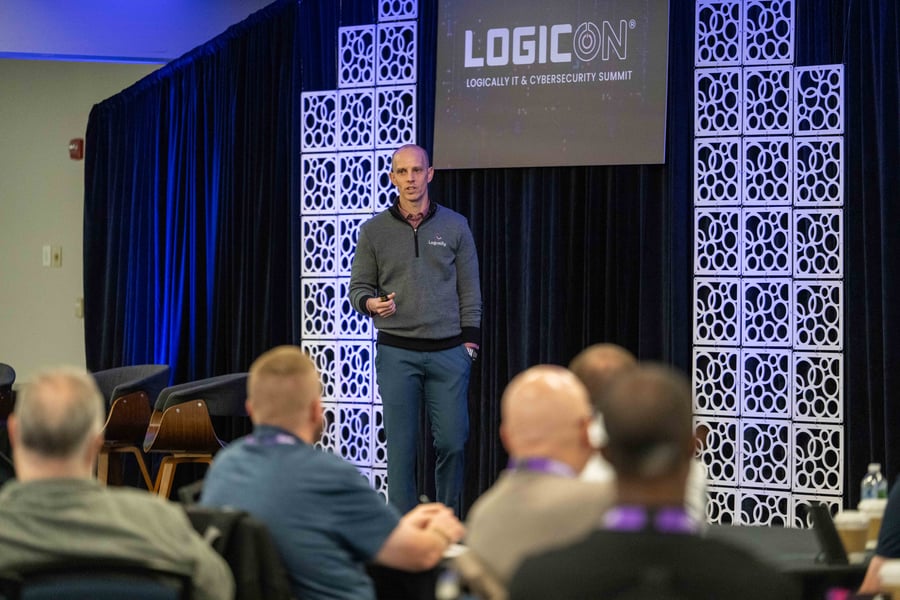
At LogicON, Joshua Skeens, CEO of Logically, identified a fundamental shift in cybersecurity:
"Trust itself has become an attack surface."
As AI-enabled attacks become more convincing, organizations must rethink how they authorize important decisions, manage connected risks and protect critical operations.
What Is AI Social Engineering, and Why Does It Matter?
AI social engineering combines traditional manipulation techniques with artificial intelligence to make fraudulent communications appear legitimate. Attackers can create realistic messages, imitate voices and fabricate video meetings to persuade employees to transfer money, disclose sensitive information or provide system access.
These attacks exploit a dangerous assumption: that familiar voices, faces and apparent agreement establish identity and authority.
A 2024 incident in Hong Kong illustrates the consequences. An employee attended a fabricated video meeting featuring apparent company executives, including the chief financial officer (CFO). The employee subsequently authorized 15 transfers to five bank accounts, resulting in losses of approximately $25 million.
The attackers did not need to compromise the company's network to initiate the fraud. They manipulated a legitimate employee into bypassing normal decision-making safeguards.
"We can no longer say that voice equals identity. That video is authority.
Urgency is an exception, or that consensus equals verification."
- Joshua Skeens, CEO
Logically
The lesson for IT leaders is clear: Security cannot depend on whether a request looks or sounds authentic.
How Can Organizations Prevent Deepfake Fraud and Executive Impersonation?
Independent verification means confirming a request through a trusted channel that was established before the suspicious request arrived. A phone number provided within an unexpected message does not qualify as independent verification, nor does agreement among participants in a potentially fabricated meeting.
Deepfake fraud is harder to prevent when a single employee can approve a high-value payment without an independent check.
Organizations should strengthen authorization processes with the following controls:
- Dual approvals: Require a second authorized individual to approve high-value or unusual financial transactions.
- Transaction thresholds: Trigger additional scrutiny when payment amounts exceed established limits.
- Trusted callbacks: Confirm changes to vendor payment instructions using previously verified contact information.
- Privileged access verification: Require independent approval before creating administrative accounts or granting elevated permissions.
- Employee empowerment: Establish clear permission to question urgent or confidential requests, regardless of the apparent sender's authority.
These safeguards protect against deepfake fraud and traditional business email compromise.
Security awareness training remains important, but it cannot replace processes that prevent one convincing interaction from triggering a consequential action.
How Should IT Leaders Manage Third-Party Cyber Risk?
Third-party cyber risk is the possibility that a vendor's systems, identities, or access could expose an organization to disruption or compromise.
The challenge is significant for mid-market organizations that depend on external providers for cloud applications, infrastructure, security and business-critical operations.
According to Verizon's 2026 Data Breach Investigations Report, third parties were involved in 48% of breaches, an increase from 30% in the previous report.
IT leaders should evaluate vendors in the context of their connections to business operations rather than treating vendor security as an isolated compliance exercise.
For every critical vendor or system, determine:
- What systems, identities and sensitive information can the vendor access?
- Is that access necessary, properly restricted and regularly reviewed?
- Who owns the relationship and its associated security risks?
- Which vulnerabilities could expose critical operations?
- How would the organization continue operating if the provider became unavailable?
Risk-based prioritization helps resource-constrained teams focus on the vulnerabilities and access paths most likely to produce significant business consequences.
The objective is not to eliminate every possible risk immediately. It is to understand which exposures matter most, assign ownership and implement measurable improvements.
What AI Governance Controls Should Organizations Implement?
AI governance defines which tools can be used, what data they may access, and which actions require human approval.
As employees adopt generative AI tools and organizations deploy AI agents, written policies alone cannot provide adequate oversight. An AI agent connected to business applications may have permissions to retrieve information, modify records or initiate transactions.
Skeens summarized the challenge:
"Contain the agent, not just the prompt."
An effective AI governance program should include:
- AI inventory: Identify approved and unapproved tools, agents, business owners and connected systems.
- Data protection boundaries: Define which information employees and agents can share with specific platforms.
- Least-privilege access: Restrict AI agents to the permissions required for authorized tasks.
- Human oversight: Require approval before agents perform consequential financial, administrative or data-related actions.
- Activity monitoring: Record important AI interactions, access requests and system changes.
- Policy maintenance: Reassess tools, permissions and data handling as business requirements evolve.
Organizations should also understand how AI providers store, process and potentially use submitted data.
Blocking AI adoption entirely can encourage unsanctioned use. Providing secure, approved alternatives makes legitimate adoption easier to manage.
Logically's AI Transformation and Governance services help organizations establish visibility, implement security controls, and create governance frameworks for responsible AI adoption.
How Does Cyber Resilience Reduce Business Disruption?
Cyber resilience is an organization's ability to prepare for, contain, respond to, and recover from cyber incidents while maintaining critical operations.
Preventive security controls reduce exposure, but organizations also need evidence and recovery capabilities when an incident occurs.
A practical cyber resilience strategy includes:
- Reliable logging: Preserve records showing who accessed systems, what changed, and when.
- Tested backups: Validate that you can restore critical applications and data within business recovery requirements.
- Incident response planning: Define roles, escalation procedures, and decision-making authority before an attack.
- Compliance readiness: Identify applicable contractual and regulatory reporting obligations.
- Business continuity: Determine how operations will continue during the loss of a critical system or service.
Tabletop exercises bring these capabilities together by testing realistic incidents before an actual emergency.
A useful exercise might simulate a compromised vendor account, a fraudulent executive payment request or an AI agent performing an unauthorized action.
Document weaknesses, assign corrective actions, and establish completion dates. A recovery plan becomes valuable when people can execute it under pressure.
What Should an IT Leader's 30/60/90-Day Security Plan Include?
An effective 30/60/90-day security plan starts with visibility and ownership, progresses to closing priority gaps, and finishes with testing response and recovery.
|
Timeline |
Priority actions |
Expected outcome |
|
First 30 days |
Assign security and AI owners, inventory critical vendors and identities, review financial approvals, identify logging gaps |
Clear accountability and visibility into high-impact risks |
|
Next 60 days |
Restrict unnecessary vendor access, strengthen AI permissions, remediate a priority exposure, test a critical backup restore |
Reduced exposure and validated technical safeguards |
|
Next 90 days |
Conduct a tabletop exercise, evaluate containment and recovery, assign remediation deadlines, update the risk roadmap |
Tested readiness and measurable security improvement |
This approach is particularly valuable for lean IT teams managing complex, multi-location environments.
Security investments should prioritize business impact, available resources, and the organization's ability to sustain improvements.
How Can Logically Help Organizations Strengthen Security and Resilience?
Protecting against AI social engineering requires more than adding another security tool. Organizations need coordinated oversight across technology operations, cybersecurity, identity, AI governance and incident response.
Logically unifies managed IT and cybersecurity through a single, accountable operating model. Its cyber-first approach combines AI-assisted monitoring with human-led expertise to help organizations reduce risk, improve visibility and strengthen operational resilience.
For organizations evaluating their next security investment, the starting point is understanding where trust, access, and accountability create the greatest exposure.
Close the Gap with Logically.
Explore Logically's Managed Cybersecurity Services or Cyber Resilience Services to assess critical risks, strengthen verification controls and prepare your business to respond when trust is exploited.

Source: The State of IT & Cybersecurity: What Changed, What's Coming, and What Matters Most LogicON Session by Joshua Skeens, CEO, Logically.
Last updated November 2026
FAQs
What is AI social engineering?
AI social engineering uses artificial intelligence to create convincing messages, voices, or videos that manipulate people into taking unauthorized actions.
How can organizations independently verify suspicious requests?
Independent verification means confirming a request through a trusted channel that was established before the suspicious request arrived.
Why is deepfake fraud difficult to prevent?
Deepfake fraud is harder to prevent when a single employee can approve a high-value payment without an independent check.
What is AI governance?
AI governance defines which tools can be used, what data they may access, and which actions require human approval.
What is third-party cyber risk?
Third-party cyber risk is the possibility that a vendor's systems, identities, or access could expose an organization to disruption or compromise.
What is cyber resilience?
Cyber resilience is an organization's ability to prepare for, contain, respond to, and recover from cyber incidents while maintaining critical operations.
What should an IT leader's 30/60/90-day security plan include?
An effective 30/60/90-day security plan starts with visibility and ownership, progresses to closing priority gaps, and finishes with testing response and recovery.