
Security Stack Consolidation: A Practical Guide for Mid-Market IT Leaders
Security stack consolidation can reduce tool sprawl, improve visibility, and streamline response. Learn a practical framework for mid-market IT leaders.
Key Takeaways
- Security stack consolidation is not simply about having fewer cybersecurity tools. It is the deliberate reduction of unnecessary overlap while improving visibility, integration, workflows, accountability, and security outcomes.
- Mid-market organizations are particularly vulnerable to cybersecurity tool sprawl because lean teams often manage hybrid infrastructure, cloud services, multiple locations, compliance requirements, and several technology vendors.
- Begin with a complete inventory and map every product to the security outcome it supports before deciding what to retain, integrate, replace, or retire.
- Calculate total operating cost, not licensing cost alone. Administration, integrations, investigation, reporting, training, and vendor management all affect the economics of a security stack.
- Technology consolidation and vendor consolidation are separate decisions. Fewer tools will not solve unclear ownership or fragmented IT and security workflows.
- Consolidate in phases and validate coverage before retiring existing tools. The goal is stronger security and resilience, not simply a smaller stack.
What is Security Stack Consolidation?
Security stack consolidation is the process of reducing unnecessary cybersecurity tool overlap while improving integration, visibility, workflows, and accountability across the environment. For mid-market IT leaders, the goal is not to own the fewest tools. It is to create a security stack the organization can effectively see, manage, and defend.
That distinction matters as organizations accumulate endpoint, identity, cloud, network, email, vulnerability, backup, compliance, and monitoring technologies. Without a coordinated operating model, more tools can create more consoles, alerts, integrations, vendor relationships, and handoffs for lean teams to manage.
The right approach to security stack consolidation connects technology decisions to measurable security outcomes.
Why Does Security Stack Consolidation Matter for Mid-Market Organizations?
Security stack consolidation matters because mid-market organizations often face enterprise-level complexity without enterprise-sized IT and cybersecurity teams.
Tool sprawl usually develops gradually. A company adds endpoint protection after one initiative, identity controls after another, cloud security as infrastructure changes, and new reporting tools as compliance requirements expand. Acquisitions, new offices, SaaS adoption, and changing providers can add additional layers.
For organizations already dealing with cybersecurity tool sprawl, the problem is not necessarily that individual products are ineffective. The problem is that products may operate independently instead of supporting one coordinated system.
This can lead to:
- Duplicate or low-value alerts
- Separate dashboards and data sources
- Inconsistent security controls
- Manual incident correlation
- Multiple vendor handoffs
- Unclear response ownership
- Underused licenses and capabilities
- Higher administrative workload
Security tool consolidation should therefore improve coordination and outcomes, not pursue an arbitrary tool count.
What Is the Difference Between Tool Consolidation and Security Stack Optimization?
Cybersecurity tool consolidation reduces unnecessary product or capability overlap, while security stack optimization improves how the remaining technologies, people, processes, and providers work together.
An organization can consolidate products and still have fragmented operations. It can also maintain several specialized tools and operate them effectively if data, workflows, responsibilities, and escalation paths are integrated.
|
Fragmented Approach |
Optimized Security Stack |
|
Signals remain in separate consoles |
Relevant signals share context |
|
Alerts compete independently for attention |
Alerts are correlated and prioritized |
|
Responsibility shifts between teams |
Ownership is clearly assigned |
|
Integrations require repeated maintenance |
Connections and workflows are standardized |
|
Manual handoffs slow investigation |
Response follows coordinated processes |
|
Cost focuses on licenses |
Total operating cost is measured against outcomes |
A specialized product can remain the right choice when it fills an important gap that a broader platform cannot address. Gartner similarly notes that consolidation requires organizations to consider whether they can eliminate specialized functionality without materially reducing effectiveness.
How Should IT Leaders Start a Security Stack Consolidation Initiative?
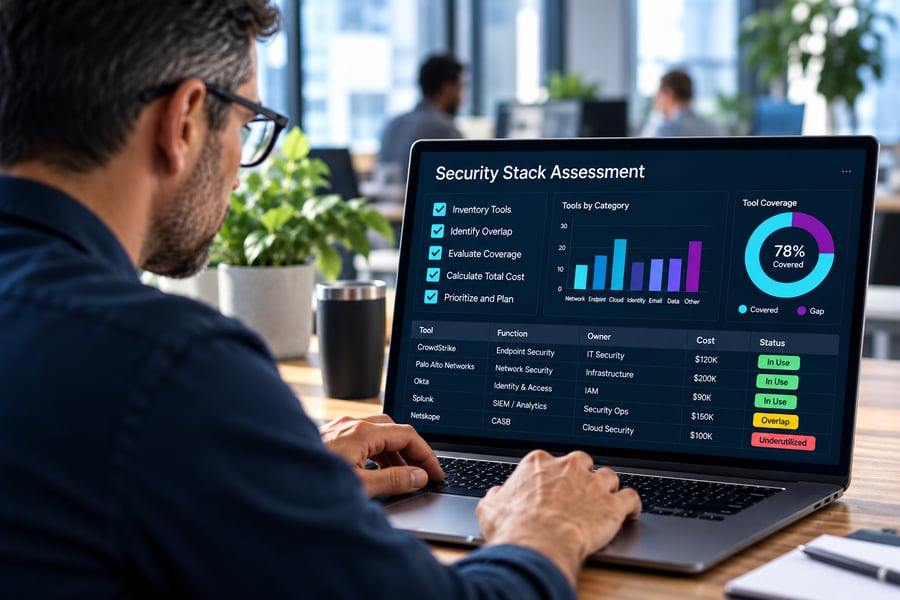
Start security stack consolidation with a complete inventory of tools, capabilities, integrations, owners, costs, and business purpose. Do not select a replacement platform before understanding what the existing environment actually does.
A practical inventory should document:
- Product and vendor
- Security function
- Business and technical owners
- Users and administrators
- Systems and users covered
- Data sources and integrations
- License count and utilization
- Annual cost and renewal date
- Compliance or reporting role
- Incident-response dependencies
Include capabilities already embedded in cloud platforms, networks, endpoint systems, identity platforms, SaaS applications, backup solutions, and managed services. Otherwise, important overlap can remain hidden.
This inventory can also support a broader cybersecurity gap analysis by showing where controls are duplicated, missing, underused, or poorly integrated.
How Do You Identify Overlapping Cybersecurity Tools?
Identify overlap by mapping each tool to the security outcome it is expected to deliver, rather than comparing feature lists alone.
Outcomes may include preventing unauthorized access, detecting endpoint behavior, protecting data, identifying vulnerabilities, securing remote access, supporting audit readiness, correlating events, containing compromised devices, or improving recovery.
Then compare capabilities across areas such as:
- Endpoint detection and response
- Identity monitoring
- Vulnerability management
- Email security
- Network monitoring
- Cloud security
- Data protection
- Event correlation
- Compliance reporting
- Backup and recovery
Not all overlap is waste. Defense in depth can intentionally place multiple controls around high-risk systems. The key question is whether each layer provides distinctive protection or simply adds cost and operational complexity.
Why Is Cybersecurity Integration as Important as Consolidation?
Cybersecurity integration determines whether tools can create shared context and coordinated action. Consolidating licenses without integrating data and workflows may leave the underlying security problem unchanged.
Evaluate integration at three levels:
- Data integration
- Workflow integration
- Process integration
Can endpoint, identity, network, cloud, vulnerability, and configuration information be connected during an investigation? Analysts should not have to manually reconstruct an incident from disconnected evidence whenever possible.
Can alerts move consistently into ticketing, escalation, containment, remediation, and reporting processes? A useful integration should support action, not simply move data between systems.
Do IT operations, cybersecurity, cloud, network, service desk, compliance teams, and outside providers know who owns each step?
This is where managed IT services and cybersecurity services can become part of the consolidation discussion. Technology performance and cybersecurity are interconnected when incidents cross infrastructure, identity, endpoint, cloud, and user-support boundaries.
What Does Cybersecurity Tool Consolidation Really Cost?
The true cost of a cybersecurity tool includes licensing plus the labor required to administer, integrate, monitor, investigate, report on, and maintain it.
Calculate operational costs such as:
- Policy and configuration management
- Integration maintenance
- Alert tuning and investigation
- Reporting and audit preparation
- User and permission administration
- Training
- Vendor and contract management
- Troubleshooting
- Incident escalation
Also consider indirect costs. A lower-cost product may become expensive if it creates duplicate investigations, slows response, requires specialized administration, or adds vendor handoffs.
The business case for cybersecurity tool consolidation should compare total operating cost with security outcomes, not simply compare subscription prices.
Which Security Tools Should You Retain, Integrate, Replace, or Retire?
Classify every tool as Retain, Integrate, Replace, or Retire based on coverage, operational value, integration quality, cost, risk, and dependencies.
Retain products that provide necessary coverage and perform effectively. Integrate valuable products that need stronger connections to surrounding systems and workflows. Replace tools when another solution can meet requirements more effectively. Retire products that add no necessary capability or sustainable operational value.
No tool should be retired until replacement coverage, historical data, integrations, compliance requirements, dependencies, and response workflows have been validated.
That discipline helps prevent a consolidation initiative from creating the security gaps it was intended to eliminate.
Should You Consolidate Cybersecurity Vendors Too?
Technology consolidation and vendor consolidation are separate decisions, but reducing fragmented vendor ownership can improve accountability when incidents cross IT and cybersecurity boundaries.
Before consolidating providers, ask whether a partner can:
- Maintain visibility across endpoints, networks, cloud, and infrastructure
- Connect service desk and security workflows
- Define ownership when incidents cross technical boundaries
- Provide continuous monitoring and clear escalation
- Support compliance and executive reporting
- Coordinate remediation as well as detection
- Scale with organizational growth and change
The objective is not simply fewer contracts. It is fewer gaps in responsibility.
Logically's current operating model brings IT operations and cybersecurity together around shared visibility, coordinated response, and clear accountability, with AI-assisted monitoring supporting speed and scale and human-led expertise guiding analysis and action.
What Are the Risks of Security Stack Consolidation?
Security stack consolidation can create new risk if organizations remove specialized capabilities, migrate too quickly, lose historical data, introduce platform dependency, or fail to validate configurations.
A phased approach helps manage those risks:
- Establish visibility. Inventory tools, owners, contracts, dependencies, and urgent gaps.
- Remove immediate waste. Address unused licenses, abandoned products, and obvious duplication.
- Improve integrations. Connect critical data, alerts, tickets, escalation paths, and reporting.
- Consolidate strategic platforms. Migrate policies and data, validate coverage, train administrators, then retire legacy products.
- Optimize continuously. Review alerts, utilization, response performance, vendor performance, architecture, and new overlap.
Maintain overlapping protection during migrations until replacement controls have been tested. Each phase should have clear owners, validation criteria, dependencies, timelines, and rollback plans.
How Do You Measure Whether Security Stack Consolidation Worked?
Successful security stack consolidation should improve measurable security and operational outcomes, not simply reduce the number of products or vendors.
Establish a baseline before making changes, then track metrics such as:
- Mean time to detect
- Mean time to investigate
- Mean time to contain
- Mean time to resolve
- Alert volume and false-positive rate
- Number of dashboards used per investigation
- Vendor handoffs during incidents
- Administrative hours per platform
- Tool utilization
- Compliance reporting time
- Annual licensing expense
- Total operating cost
The strongest outcome is a security environment that gives teams better visibility, clearer ownership, faster coordinated response, and sustainable operating effort.
How Can Logically Help Close the Gap?
Security stack consolidation works best when technology, workflows, and accountability are evaluated together. A smaller stack alone will not fix fragmented operations.
Logically unifies IT operations and cybersecurity through one accountable operating model designed to reduce blind spots, coordinate response, and strengthen resilience. That approach aligns security stack optimization with the systems, people, and business processes the organization depends on.
If tool sprawl, disconnected vendors, unclear ownership, or rising operating effort are making your environment harder to manage, talk with Logically about your IT and cybersecurity environment. A consultation can help identify where consolidation, integration, or clearer accountability can reduce complexity without creating new security gaps.
FAQs
What is security stack consolidation?
Security stack consolidation is the process of reducing unnecessary cybersecurity tool overlap while improving integration, visibility, workflows, and accountability across the environment.
What is the difference between cybersecurity tool consolidation and security stack optimization?
Cybersecurity tool consolidation reduces unnecessary product or capability overlap, while security stack optimization improves how the remaining technologies, people, processes, and providers work together.
How should an organization start security stack consolidation?
Start security stack consolidation with a complete inventory of tools, capabilities, integrations, owners, costs, and business purpose.
Why is cybersecurity integration important during consolidation?
Cybersecurity integration determines whether tools can create shared context and coordinated action. Consolidating licenses without integrating data and workflows may leave the underlying security problem unchanged.
How should organizations measure security stack consolidation?
Successful security stack consolidation should improve measurable security and operational outcomes, not simply reduce the number of products or vendors.