
Cybersecurity Tool Sprawl: Why Companies Struggle
Cybersecurity tool sprawl fragments visibility, increases alert fatigue, and slows response. Learn how to simplify tools without creating new security gaps.
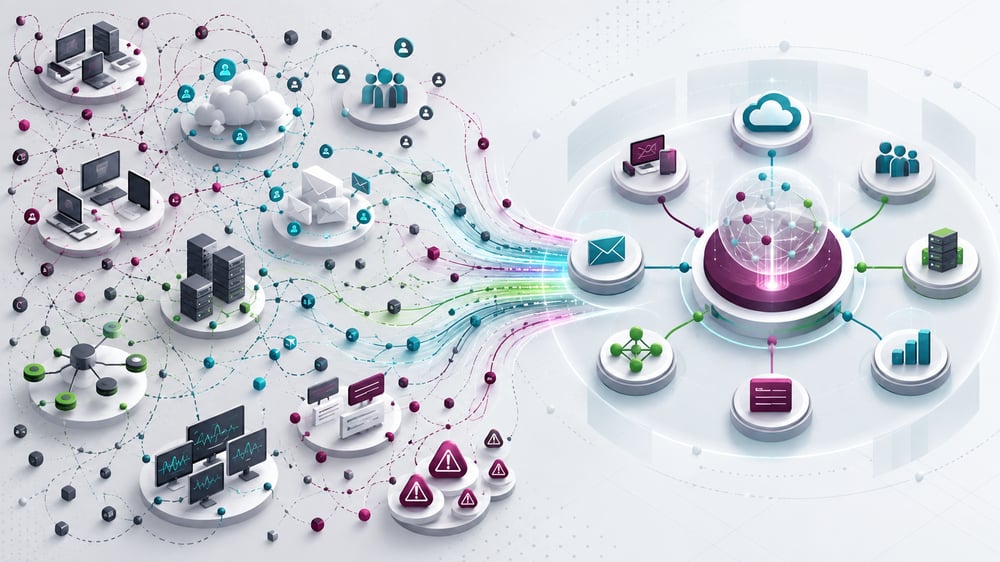
Key Takeaways
- Cybersecurity tool sprawl becomes difficult when security products operate independently instead of as one coordinated system.
- Separate cybersecurity tools can reduce security visibility by forcing teams to correlate identity, endpoint, cloud, network, and other signals manually.
- Duplicate and low-value alerts contribute to alert fatigue and make meaningful risk harder to prioritize.
- Integration complexity increases as APIs, platforms, configurations, permissions, and workflows change.
- Security tool consolidation should improve coordination and outcomes, not simply reduce the number of products.
- Sustainable security operations require clear ownership, integrated workflows, and measurable performance across the environment.
Why does cybersecurity tool sprawl make security harder to manage?
Cybersecurity tool sprawl makes separate security products difficult to manage because each tool can solve a narrow problem while fragmenting data, alerts, workflows, policies, and ownership across the wider environment. For mid-market organizations with lean IT teams, that fragmentation can reduce security visibility, increase alert fatigue, and slow security operations even when the individual tools work as intended.
Hybrid infrastructure, cloud services, SaaS applications, endpoints, multiple locations, and compliance demands all add operational load. The issue is not simply having many cybersecurity tools. The issue is whether those tools work together as a coordinated system.
What is cybersecurity tool sprawl?
Cybersecurity tool sprawl occurs when an organization accumulates security products faster than it can integrate, govern, and operate them as one coordinated system.
This often develops gradually. A team adds endpoint protection, identity controls, email security, network monitoring, cloud security, vulnerability management, ticketing, and other point solutions as new needs arise. Individually, those products may work well. Collectively, they can create complex integration, inconsistent processes, and unclear ownership if no operating model connects them.
For lean teams, the burden grows quickly. Each new console brings its own settings, alerts, reporting, permissions, training, vendor relationships, and maintenance requirements.
How does cybersecurity tool sprawl affect security visibility and alert fatigue?
Separate cybersecurity tools create security visibility gaps when identity, endpoint, cloud, network, email, and ticketing data cannot be correlated quickly enough to show one coherent incident story.
An identity anomaly may be related to an endpoint event or a cloud configuration change, but separate consoles force analysts to assemble the evidence manually. That slows investigation and makes it harder to determine what happened, what is affected, and who owns the next action.
Why does tool sprawl create alert fatigue?
Multiple products may flag the same behavior in different ways or generate large volumes of low-value notifications. Alert fatigue grows when analysts must spend too much time separating duplicate, low-priority, or false-positive alerts from activity that represents meaningful risk.
Good security visibility is not a bigger pile of alerts. It is enough context to prioritize the right work.
Why does integration complexity slow security operations?
Integration complexity grows because APIs, vendor platforms, permissions, data formats, and workflows change over time. Security operations teams must maintain those connections continuously or risk losing the context and automation they were supposed to provide.
A one-time integration project does not solve the problem permanently. As environments evolve, broken connectors, stale rules, duplicated workflows, and inconsistent configurations can reintroduce gaps. Integration complexity also increases dependency on scarce internal expertise, especially when no single team owns the entire process.
What does cybersecurity tool sprawl cost?
The cost extends beyond licensing. Organizations also pay for training, integration maintenance, vendor management, duplicate capabilities, reporting effort, and the staff time required to switch between systems.
Before consolidating tools, companies should baseline alert volume, false positives, investigation time, response time, manual handoffs, tool utilization, administrative effort, licensing costs, and total operating cost.
These measures help leaders compare the current state against a future one. A lower product count is not automatically better if it reduces coverage or creates new dependencies. The goal is to improve outcomes and make security operations sustainable.
When does security tool consolidation make sense?
Security tool consolidation makes sense when overlapping products, disconnected workflows, or unsustainable administration are reducing security outcomes. The objective should be better coordination, not an arbitrary reduction in tool count.
Security tool consolidation does not mean replacing every cybersecurity product; it means reducing unnecessary overlap while preserving specialized tools that provide clear value.
|
Operating Area |
Fragmented Security Stack |
Coordinated Operating Model |
|
Visibility |
Signals remain in separate consoles |
Relevant signals share context |
|
Alerts |
Duplicate or low-value notifications compete for attention |
Alerts are correlated and prioritized |
|
Ownership |
Responsibility can shift between teams or vendors |
Ownership is clearly assigned |
|
Integrations |
Point-to-point connections require repeated maintenance |
Connections and workflows are standardized |
|
Response |
Manual handoffs slow investigation |
Work moves through coordinated processes |
|
Cost |
Licensing can obscure administrative and operating costs |
Total operating cost is measured alongside outcomes |
A specialized product can remain the right choice when it fills a specific gap that broader platforms cannot address. Security tool consolidation is useful only when it improves coverage, clarity, and response.
How should companies improve their security stack?
Start with a complete inventory of cybersecurity tools, capabilities, integrations, owners, contracts, costs, and business purpose. That exposes overlap, unused products, unsupported integrations, and controls that exist on paper but are not consistently operated.
Next, map the operating model around the stack. Determine how signals enter the environment, who investigates them, how incidents move between IT and security, which systems are authoritative, and where manual handoffs occur. This is where security visibility, integration complexity, and accountability become measurable rather than abstract.
Then test decisions against business outcomes. Keep, replace, consolidate, or integrate tools based on whether each change improves detection, response, consistency, reporting, and resilience. Clear ownership matters as much as technology.
Who should review their cybersecurity tools most closely?
Mid-market organizations with hybrid environments, multiple locations, lean IT teams, compliance pressure, or rapid growth should review their security stack regularly because complexity can outpace internal capacity. Those conditions are where fragmented cybersecurity tools and providers can create the most operational friction.
An outside security partner can help when internal teams lack the bandwidth or specialized expertise to maintain integrations, monitor across systems, coordinate response, and manage security consistently across complex infrastructure.
A Security Assessment can establish the current-state baseline. Managed IT Services, Cybersecurity Services, SOC as a Service, or vCISO Services can then address specific gaps without assuming every organization needs the same model.
How can Logically close the gaps between tools, teams, and workflows?
Cybersecurity tool sprawl becomes a business problem when fragmentation limits visibility, slows response, increases operating effort, and leaves ownership unclear. The better strategy is to connect security decisions to a coordinated operating model.
Logically brings IT operations and cybersecurity together around shared visibility, integrated workflows, and clear accountability. AI-assisted monitoring can help surface signals at speed and scale, while human-led expertise provides context, prioritization, and accountable action.
The right security strategy is not about collecting more tools. It is about creating stronger security visibility, more sustainable security operations, and a technology environment that supports resilience as the business changes.
Close the Gap with Logically.
FAQs
What is cybersecurity tool sprawl?
Cybersecurity tool sprawl occurs when an organization accumulates security products faster than it can integrate, govern, and operate them as one coordinated system.
Why do separate cybersecurity tools create security visibility gaps?
Separate cybersecurity tools create security visibility gaps when identity, endpoint, cloud, network, email, and ticketing data cannot be correlated quickly enough to show one coherent incident story.
How does cybersecurity tool sprawl contribute to alert fatigue?
Alert fatigue grows when analysts must spend too much time separating duplicate, low-priority, or false-positive alerts from activity that represents meaningful risk.
Does security tool consolidation mean replacing every cybersecurity product?
Security tool consolidation does not mean replacing every cybersecurity product; it means reducing unnecessary overlap while preserving specialized tools that provide clear value.
What should companies measure before consolidating cybersecurity tools?
Before consolidating tools, companies should baseline alert volume, false positives, investigation time, response time, manual handoffs, tool utilization, administrative effort, licensing costs, and total operating cost.
When should an organization consider an outside security partner?
An outside security partner can help when internal teams lack the bandwidth or specialized expertise to maintain integrations, monitor across systems, coordinate response, and manage security consistently across complex infrastructure.