
Cybersecurity Best Practices for Businesses in 2026
Follow six cybersecurity best practices for businesses to reduce risk, strengthen security posture, protect data, and build cyber resilience in 2026.
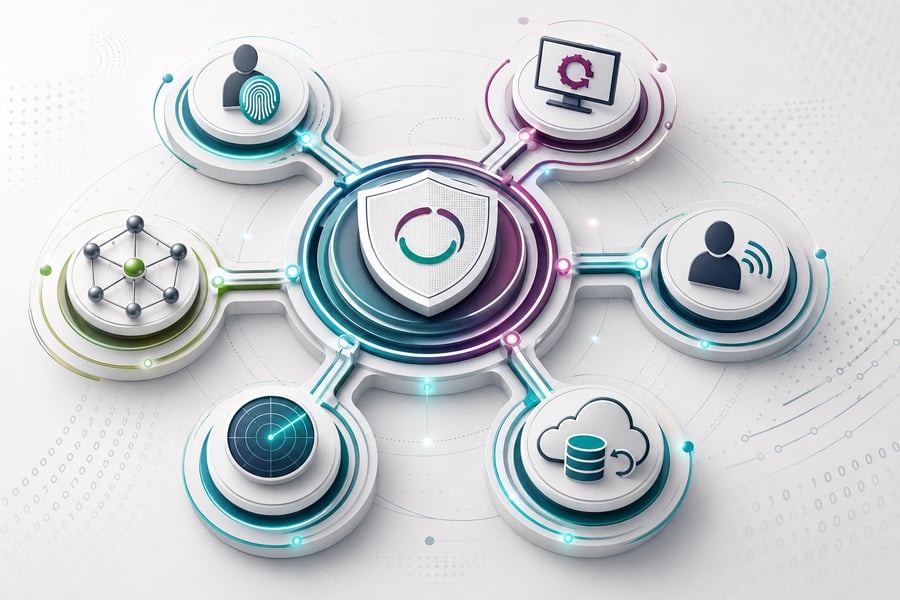
Key Takeaways
- The most effective cybersecurity best practices for businesses combine identity protection, patching, employee awareness, resilient backups, continuous monitoring, and network security.
- Vulnerability exploitation has become the leading initial breach entry point according to Verizon’s 2026 DBIR, increasing the importance of disciplined vulnerability and patch management.
- Human behavior remains a major security factor, so recurring awareness training should complement technical controls.
- Backups must be isolated, protected, and tested for recovery, not simply created.
- Mid-market organizations with lean IT teams benefit from treating IT operations and cybersecurity as one coordinated discipline rather than separate responsibilities.
Cybersecurity best practices for businesses start with six fundamentals: protect identities, patch vulnerabilities, train employees, maintain recoverable backups, monitor threats continuously, and secure the network. For mid-market organizations, getting these basics right can materially reduce exposure without requiring internal teams to manage every security challenge alone.
The need is becoming more urgent. Verizon's 2026 Data Breach Investigations Report found that vulnerability exploitation has become the most common initial breach entry point, while the non-intentional human element contributed to 62% of breaches. Those findings reinforce a simple principle: stronger technology controls and better human decision-making have to work together.
Here is a practical cybersecurity checklist organizations can use to strengthen their security posture and build greater cyber resilience.
What Cybersecurity Best Practices Should Businesses Prioritize?
The strongest cybersecurity best practices for businesses focus first on controls that reduce common paths attackers use to enter an environment, expand access, or disrupt operations.
1. How Should Businesses Strengthen Password and Identity Security?
Start by reducing dependence on passwords alone.
Use an enterprise password manager to create and securely store unique passwords. Establish password policies based on current guidance rather than relying on arbitrary periodic password changes.
Most importantly, require multifactor authentication (MFA) for business accounts. CISA recommends organizations aim for phishing-resistant MFA because it provides stronger protection against credential theft and phishing.
Prioritize MFA for:
- Email and Microsoft 365 or other cloud applications
- Virtual private network access
- Administrator and privileged accounts
- Financial and payroll systems
- Remote access tools
Identity controls are particularly important because a stolen password should not be enough to give an attacker access to critical systems.
2. Why Are Software Updates and Patching Critical?
Patching closes known vulnerabilities before attackers can exploit them. In 2026, that has become even more important because vulnerability exploitation has surpassed stolen credentials as the leading breach entry point.
Create a defined vulnerability and patch-management process instead of treating updates as an occasional maintenance task.
Organizations should:
- Prioritize known exploited and internet-facing vulnerabilities
- Automate routine endpoint and application updates where appropriate
- Test updates to firewalls, production systems, and other sensitive infrastructure before deployment
- Remove unnecessary or unsupported applications
- Regularly review application access and permissions
The goal is not simply to install every update immediately. It is to manage vulnerability risk quickly without creating unnecessary operational disruption.
How Can Employees Improve an Organization's Security Posture?
People are an essential part of a strong security posture. Verizon's 2026 DBIR found that the non-intentional human element contributed to 62% of breaches.
Security awareness therefore needs to be continuous rather than a once-a-year compliance exercise.
Train employees to recognize phishing, credential harvesting, suspicious MFA requests, social engineering, and unusual payment or data-access requests. Reinforce the training with simulated exercises and a simple way to report suspicious activity.
Organizations should also establish clear policies for handling sensitive information and emerging technologies.
For a deeper discussion of building security-conscious behavior, listen to Logically's Trained to Protect: Creating a Culture of Security.
How Should Businesses Back Up Data for Cyber Resilience?
A backup is valuable only if the organization can restore clean data when production systems are unavailable or compromised.
Effective cyber resilience requires organizations to maintain protected copies of critical data, isolate them from production environments, and regularly test restoration procedures. CISA specifically recommends maintaining offline backups and testing the restoration process as part of ransomware preparedness.
A resilient backup strategy should include:
- Automated backups of critical systems and data
- Separation between production and backup environments
- Offline or otherwise isolated copies of essential data
- Encryption and controlled access
- Routine recovery testing
Testing matters because discovering that a backup is incomplete or unusable during an incident is too late.
Why Is Continuous Threat Monitoring Important?
Cyber incidents do not follow business hours. Continuous monitoring helps organizations identify suspicious activity earlier and coordinate a faster response.
Modern security programs should combine endpoint protection, threat detection, centralized visibility, actionable alerting, and defined incident-response processes.
The challenge is avoiding alert fatigue. Teams that receive thousands of undifferentiated notifications can miss the events that matter most.
Logically addresses this challenge through an AI-assisted, human-led approach. Technology helps analyze activity at speed and scale, while security experts apply judgment to investigation, response, and remediation. Bringing IT operations and cybersecurity into one coordinated model also reduces the blind spots and handoff delays that fragmented providers can create.
What Network Security Controls Should Businesses Use?
Network security limits attacker access and makes lateral movement more difficult after an initial compromise.
Include these controls in your cybersecurity checklist:
- Use current encryption standards for wireless and remote connections.
- Replace default credentials and unnecessary default configurations.
- Segment production, guest, operational technology, and other sensitive networks where appropriate.
- Configure firewalls according to business requirements and risk.
- Review remote access and administrative pathways.
- Maintain visibility into encrypted traffic where inspection is appropriate and compatible with privacy, operational, and regulatory requirements.
Segmentation is especially valuable in multi-location or complex environments because it can restrict how far a compromised account or device can reach.
How Do These Practices Work Together?
No single cybersecurity control is sufficient. Cybersecurity best practices for businesses work as a system.
Strong identity controls make unauthorized access harder. Vulnerability management closes technical entry points. Employee awareness reduces social-engineering risk. Backups support recovery. Monitoring helps identify attacks earlier. Network controls help contain them.
That interconnected approach is also why IT performance and cybersecurity should not operate in silos. A configuration change, unpatched device, identity issue, or network outage can become both an operational problem and a security problem.
Build Cyber Resilience with a Cyber-First Approach
Improving cybersecurity does not require solving every risk at once. Start with the controls that reduce the most common attack paths, establish clear accountability, and strengthen them continuously as your environment changes.
For mid-market organizations with lean IT teams, a unified approach can provide stronger visibility and reduce the burden of coordinating multiple tools and providers. Logically brings IT operations and cybersecurity together under one accountable operating model to help organizations reduce risk, respond faster, and strengthen cyber resilience.
Explore Logically's security resource center for more practical cybersecurity guidance, or speak with our experts about strengthening your organization's security posture.
Last updated August 2026
FAQs
What are the most important cybersecurity best practices for businesses?
Businesses should prioritize identity security and MFA, vulnerability and patch management, employee security awareness, protected backups, continuous threat monitoring, and network security. Together, these controls reduce common attack paths and improve an organization's ability to detect, contain, and recover from incidents.
How often should businesses change employee passwords?
Businesses should not rely on arbitrary scheduled password changes as their primary identity-security control. They should emphasize strong unique passwords, password managers, compromised-password screening, and multifactor authentication, with passwords changed when compromise is suspected or required by applicable policy.
Why is multifactor authentication important?
Multifactor authentication requires more than one form of verification, so obtaining a password alone is less likely to give an attacker account access. Organizations should use phishing-resistant MFA where practical, particularly for privileged and sensitive accounts.
How quickly should businesses install security patches?
Businesses should prioritize patches according to risk, giving the highest urgency to actively exploited vulnerabilities and internet-facing systems. Routine updates can often be automated, while changes to sensitive infrastructure should be tested to reduce the risk of operational disruption.
What is the best backup strategy for ransomware?
Maintain multiple protected copies of critical data, separate backup systems from production, keep an offline or otherwise isolated copy where appropriate, restrict access, and test restoration regularly. A backup strategy should be designed around successful recovery, not simply data duplication.
How does security awareness training reduce cyber risk?
Security awareness training helps employees recognize phishing, social engineering, suspicious authentication requests, and unusual requests for data or payments. Recurring training and simulations make employees better prepared to respond when an actual attack occurs.
How can a managed cybersecurity provider improve security posture?
A managed cybersecurity provider can supplement internal teams with continuous monitoring, specialized security expertise, threat detection, incident response, vulnerability management, and strategic guidance. An integrated provider can also coordinate IT and security activities that might otherwise be divided among separate teams or vendors.