AI Data Governance: Secure Your Data for AI Readiness
Learn how AI data governance reduces data sprawl, strengthens security, and helps mid-market businesses adopt AI with confidence and control.

Key Takeaways
- Data sprawl is a major barrier to AI readiness. When information is scattered across cloud platforms, business applications, and disconnected systems, organizations lose visibility into where data resides and who can access it.
- AI data governance is the foundation for secure AI adoption. Organizations must understand, classify, and control their data before expanding AI access or enabling autonomous workflows.
- MCP and centralized data architectures serve different purposes. Model Context Protocol enables AI to connect with existing applications, while data lakes and warehouses provide centralized environments for managing and analyzing information.
- Poor permissions become more dangerous when AI makes information easier to find. AI can surface sensitive information that employees were technically authorized to access but would not ordinarily discover.
- Organizations do not need perfect data to begin using AI. A phased strategy using approved tools, low-risk data, read-only permissions, and employee education can establish a secure foundation.
- Data quality and governance influence AI outcomes as much as model selection. Reliable information, appropriate controls, and human oversight help organizations turn AI investments into measurable business value.
AI Data Governance: How to Control Data Sprawl and Prepare for Secure AI Adoption
AI data governance is the process of controlling how organizational data is accessed, protected, managed, and used by artificial intelligence systems. It is essential for businesses preparing to adopt AI because disconnected applications, inconsistent permissions, and unreliable information can introduce security risks and undermine AI-generated results.
For mid-market organizations, the challenge is not simply choosing the right AI platform. It is understanding what information already exists across the business and ensuring AI can use it appropriately.
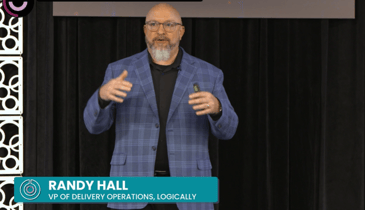
During LogicOn’s Data Mayhem discussion, CIO Chris Morton joined Eric Russo, Head of Security at Hatz AI, and Callen Sapien, CEO of Synthreo, to explore how organizations can regain control of their information and build a practical foundation for secure AI adoption.
What Is Data Sprawl, and Why Does It Threaten AI Readiness?
Data sprawl occurs when business information becomes distributed across multiple applications, cloud environments, devices, and storage systems without consistent visibility or governance. It creates operational complexity and makes it difficult to determine which information is accurate, sensitive, or accessible.
Not long ago, IT teams could often identify where critical information lived. Business applications and databases operated within relatively centralized environments, supported by established backup procedures, security controls, and administrative oversight.
Today, Software-as-a-Service (SaaS) applications have changed that model.
Finance, sales, human resources, operations, and IT departments rely on different systems to manage information. Each platform introduces its own permissions, data structures, and security considerations.
For mid-market organizations without dedicated data engineering teams, maintaining visibility across these systems can be difficult.
The consequences extend beyond cybersecurity. Fragmented or conflicting information can lead to inaccurate reporting, inefficient operations, and poor business decisions.
AI increases those risks because it can retrieve, analyze, and distribute information much faster than employees performing the same tasks manually.
Why Is AI Data Governance Essential for Business Security?
AI data governance helps organizations ensure that AI systems access appropriate information, follow established security policies, and operate within defined business boundaries.
When businesses connect AI to applications such as Microsoft 365, Salesforce, or SharePoint, they must understand what information those systems contain and which permissions AI may inherit.
Russo described an example involving an organization that connected its SharePoint environment to an AI application. An employee subsequently discovered confidential executive compensation information through an AI conversation.
The underlying issue was not necessarily unauthorized access. The information was already available through existing permissions. AI simply made it easier to discover.
This distinction matters.
Traditional access controls may technically function as designed while still exposing information more broadly than business leaders intended.
Organizations should therefore review three areas before connecting AI to enterprise data:
- Data visibility: Identify what information exists, where it resides, and who owns it.
- Data classification: Distinguish public, internal, confidential, and highly restricted information.
- Access permissions: Verify that users and AI integrations have only the access necessary to perform approved tasks.
Sensitive information also extends beyond financial records and personally identifiable information (PII).
Proprietary processes, intellectual property, product designs, and internal operating procedures may require additional protection, even when customer names and financial details have been removed.
How Can Organizations Connect AI to Enterprise Data Securely?
Organizations can connect AI to business information through centralized data platforms, Model Context Protocol integrations, or a combination of both. The appropriate architecture depends on data maturity, operational requirements, available resources, and security controls.
What Is Model Context Protocol?
Model Context Protocol (MCP) is an open standard that enables AI applications to connect with external data sources, tools, and business systems through standardized interfaces.
Instead of developing a separate custom integration for every AI use case, organizations can use supported MCP servers to make relevant application capabilities available to AI.
MCP can simplify integration, but the protocol does not automatically guarantee secure access.
Organizations must independently verify authentication, authorization, permissions, activity logging, and restrictions on actions an AI agent can perform.
MCP vs. Data Lakes: Which Architecture Is Better for AI?
A data lake or warehouse centralizes information for reporting, analysis, and governance. MCP enables AI to interact with information and tools available through connected applications.
|
Consideration |
MCP Integrations |
Data Lakes and Warehouses |
|
Primary purpose |
Connect AI to applications and tools |
Centralize data for analysis and management |
|
Implementation |
Potentially faster with supported connectors |
Requires data pipelines and ongoing management |
|
Data location |
Often remains in source applications |
Consolidated into a managed environment |
|
Governance |
Depends on configured access and integration controls |
Depends on centralized policies and data controls |
|
Best fit |
Incremental AI adoption and application-specific workflows |
Cross-system reporting, analytics, and data reconciliation |
The panelists agreed that these approaches are not mutually exclusive.
Organizations with established data infrastructure can continue using those investments while introducing MCP integrations for specific AI workflows.
For businesses beginning their AI journey, connecting a small number of well-governed applications may be more practical than immediately building an enterprise data lake.
How Can Businesses Improve AI Readiness Without Increasing Risk?
Businesses can improve AI readiness by starting with approved tools, classifying data, auditing permissions, and expanding AI capabilities gradually. A controlled implementation allows organizations to validate security and business value before introducing higher-risk automations.
The panel recommended a phased approach:
1. Assess Data Visibility and Ownership
Identify the applications employees use, the information each application stores, and the individuals responsible for managing it.
Prioritize systems containing customer information, financial records, intellectual property, and operationally critical data.
2. Establish Data Classification and Access Controls
Define which information AI may access and which information requires restrictions.
Review excessive permissions before enabling integrations, especially within Microsoft 365, SharePoint, and other widely used collaboration platforms.
3. Start with Lower-Risk AI Use Cases
Introduce approved AI tools for tasks such as drafting general communications, summarizing non-sensitive information, or researching internal knowledge resources.
Begin with limited integrations and read-only permissions wherever possible.
4. Introduce Automation with Human Oversight
AI agents can take actions, not just generate answers.
Sapien described an experience in which an AI agent completed a contract review and unexpectedly emailed the results because sending permissions had been enabled.
The lesson is straightforward: AI agents should receive only the permissions required for their assigned tasks, with human approval for sensitive or irreversible actions.
5. Monitor Results and Expand Responsibly
Track AI usage, information quality, security events, employee adoption, and operating costs.
Expand access and automation only when the organization can demonstrate that existing controls are effective.
This staged approach aligns with the NIST AI Risk Management Framework, which organizes AI risk management around governing, mapping, measuring, and managing risks.
How Does Data Quality Affect AI Accuracy and ROI?
AI systems can produce misleading results when they rely on incomplete, outdated, or conflicting business information. Reliable AI outcomes require clearly defined sources of truth, appropriate data context, and human validation.
Consider an organization where finance, sales, and operations maintain different versions of customer records.
An AI system might analyze each dataset correctly yet produce conflicting reports because the underlying information differs.
The panel emphasized establishing an authoritative source for important business information.
For example, signed contracts and verified financial records may serve as authoritative references for contractual obligations and revenue reporting.
Data owners should also document how conflicting records are resolved.
Model performance and cost matter, but organizations should evaluate AI return on investment (ROI) through practical business outcomes, including:
- Time saved on approved workflows
- Improved accuracy of reports and decisions
- Reduced manual effort and rework
- Lower operating costs per completed task
- Fewer security or compliance exceptions
Selecting a more expensive AI model cannot compensate for unreliable data or weak governance.
Why Does Employee Education Matter for AI Security?
Employee education is essential because technical controls alone cannot prevent every form of unauthorized or inappropriate AI usage.
When organizations prohibit AI without providing acceptable alternatives, employees may turn to personal accounts or unmanaged tools.
This behavior, often called shadow AI, limits visibility into how business information is shared and processed.
The panel highlighted the importance of making approved AI tools the easiest option for employees.
Organizations should explain what information can be entered into AI applications, which workflows are approved, and when human review is required.
Policies must also address the handling of proprietary processes, not just personal or financial information.
Effective AI security combines technical safeguards, practical training, clear accountability, and ongoing oversight.
How Can Logically Help Organizations Strengthen AI Data Governance?
Logically helps mid-market organizations adopt AI securely by combining governance, data protection, technical readiness, and expert-led enablement within an integrated IT and cybersecurity operating model.
Rather than treating AI as a standalone technology initiative, Logically helps businesses address the underlying gaps that can limit successful adoption.
Through its AI Transformation services, Logically supports organizations with AI readiness assessments, shadow AI visibility, Microsoft Copilot readiness, governance policies, and secure AI implementation.
Its LogicAI managed AI offering provides a governed environment designed to help organizations manage AI access, protect sensitive information, and introduce AI workflows responsibly.
The objective is not to eliminate every risk before using AI. It is to establish appropriate controls, maintain visibility, and scale AI based on demonstrated business value.
Ready to strengthen AI data governance and move forward with greater confidence?
Explore Logically's AI Transformation services to identify data and security gaps, establish practical governance controls, and build a secure foundation for AI adoption.

Last updated November 2026
FAQs
What is AI data governance?
AI data governance is the process of controlling how organizational data is accessed, protected, managed, and used by artificial intelligence systems.
What is data sprawl?
Data sprawl occurs when business information becomes distributed across multiple applications, cloud environments, devices, and storage systems without consistent visibility or governance.
What is Model Context Protocol?
Model Context Protocol (MCP) is an open standard that enables AI applications to connect with external data sources, tools, and business systems through standardized interfaces.
How can businesses improve AI readiness without increasing risk?
Businesses can improve AI readiness by starting with approved tools, classifying data, auditing permissions, and expanding AI capabilities gradually.
How does poor data quality affect AI results?
AI systems can produce misleading results when they rely on incomplete, outdated, or conflicting business information.
How does Logically help businesses with AI data governance?
Logically helps mid-market organizations adopt AI securely by combining governance, data protection, technical readiness, and expert-led enablement within an integrated IT and cybersecurity operating model.