
2025 Cybersecurity Readiness Scorecard
Assess your cyber readiness with a practical scorecard covering threat monitoring, MFA, backup recovery, risk assessments, and high-impact security investments.
Key Takeaways
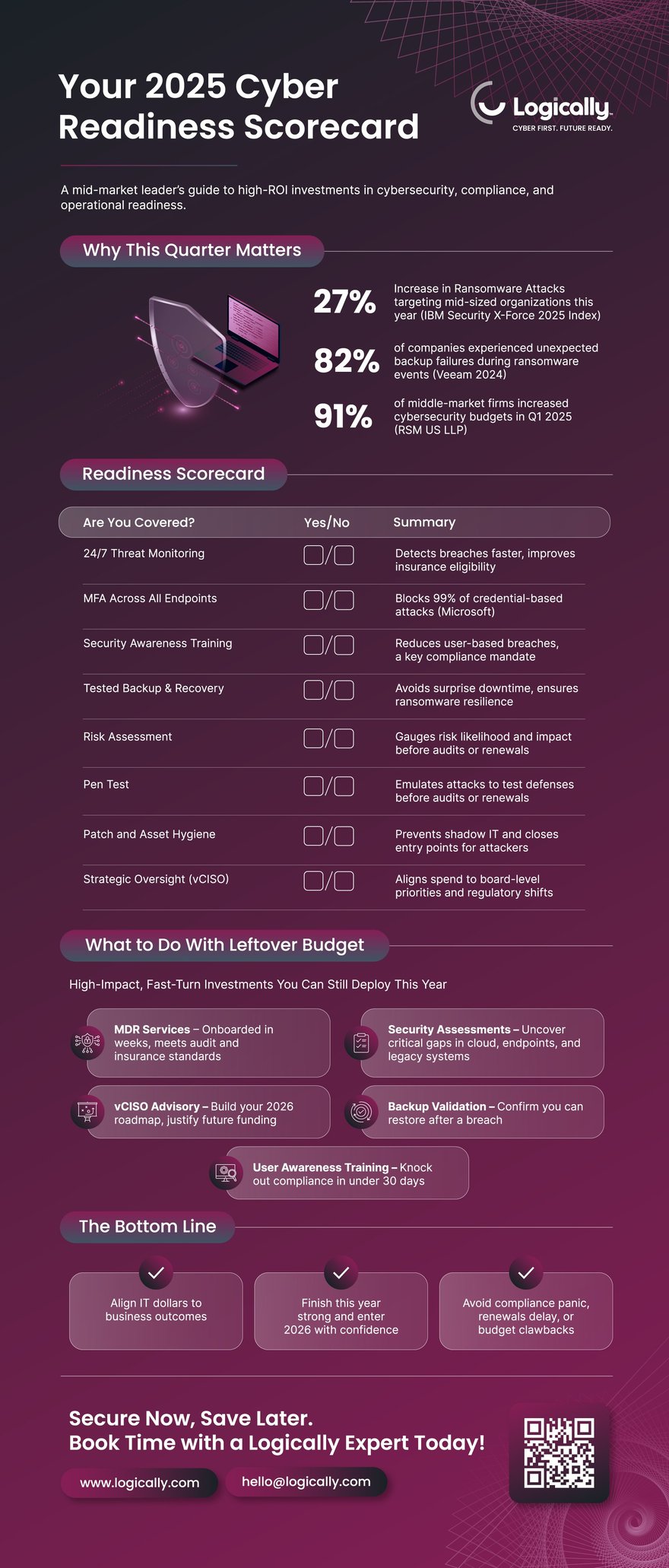
- Cybersecurity readiness depends on more than buying tools. Your organization needs continuous monitoring, strong identity controls, tested recovery processes, current assets, and clear executive oversight.
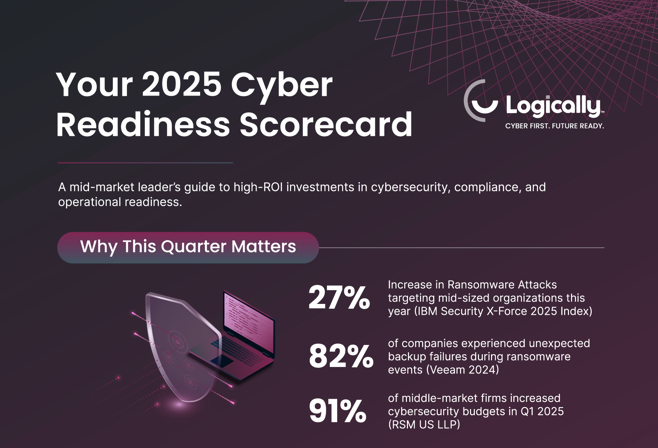
- Ransomware risk remains a major concern for mid-market organizations, especially when backup failures, weak endpoint controls, or untested recovery plans create avoidable exposure.
- Twenty-four-hour threat monitoring can help your organization detect incidents faster and may support cyber insurance requirements.
- Multi-factor authentication across all endpoints reduces the risk of credential-based attacks and should be treated as a baseline security control.
- Security awareness training helps reduce user-driven incidents and supports compliance obligations.
- Backup and recovery capabilities should be tested, not assumed. Validation confirms whether your organization can restore systems after ransomware, data loss, or operational disruption.
- Risk assessments and penetration tests help you identify weaknesses before audits, renewals, or real-world attacks expose them.
- Patch and asset hygiene reduce shadow IT, close known entry points, and improve visibility across your environment.
- A virtual Chief Information Security Officer, or vCISO, can help align cybersecurity spending with business priorities, compliance requirements, and future planning.
- Leftover budget can still be used for high-impact initiatives such as managed detection and response, security assessments, vCISO advisory, backup validation, and user awareness training.
- The strongest year-end investments are those that improve immediate resilience while preparing your organization for the next budget cycle.
FAQs
What is a cyber readiness scorecard?
A cyber readiness scorecard is a practical checklist used to evaluate whether your organization has essential cybersecurity controls in place. It typically reviews monitoring, identity protection, employee training, backup testing, risk assessments, penetration testing, asset hygiene, and strategic oversight.
Why is 24/7 threat monitoring important?
Twenty-four-hour threat monitoring helps detect suspicious activity faster, reduce response time, and limit the impact of a breach. It may also support cyber insurance eligibility and incident response requirements.
Why should multi-factor authentication be used across all endpoints?
Multi-factor authentication adds an additional verification step beyond a password. This helps reduce the risk of credential-based attacks, account takeover, and unauthorized access.
How does security awareness training reduce cyber risk?
Security awareness training teaches employees how to recognize phishing, social engineering, suspicious links, and unsafe behavior. It reduces user-driven incidents and helps your organization meet compliance requirements.
Why should backup and recovery systems be tested?
Backups are only useful if they can be restored successfully. Regular backup validation confirms that your organization can recover critical systems and data after ransomware, hardware failure, or another disruptive event.
What is the difference between a risk assessment and a penetration test?
A risk assessment identifies and prioritizes potential threats, vulnerabilities, and business impacts. A penetration test actively simulates attacks to determine whether security weaknesses can be exploited.
What is patch and asset hygiene?
Patch and asset hygiene is the ongoing process of identifying devices, software, and systems, applying updates, removing unsupported assets, and reducing shadow IT. It helps close known security gaps and improve visibility.
What does a vCISO do?
A virtual Chief Information Security Officer provides strategic cybersecurity leadership without requiring a full-time executive hire. A vCISO can help align security investments with business goals, compliance obligations, board priorities, and long-term planning.
How can leftover cybersecurity budget be used effectively?
Leftover budget can be used for high-impact initiatives that can often be deployed quickly, including managed detection and response, security assessments, vCISO advisory, backup validation, and employee awareness training.
What cybersecurity investments can deliver value quickly?
Initiatives such as managed detection and response, focused security assessments, backup testing, employee training, and short-term advisory services can improve resilience quickly while supporting future planning.