
Cybersecurity Posture for Restaurant Groups
Passing location audits does not prove restaurant cybersecurity at enterprise scale. Learn how standardization improves visibility, control, and audit readiness.
Key Takeaways
- A passing location audit validates one restaurant at a point in time. It does not prove that the same security controls are consistently enforced across the entire restaurant group.
- MFA gaps, uneven EDR coverage, unreconciled firewall rules, and vendor access exceptions can compound across locations and define the organization's actual cybersecurity posture.
- The 2026 Verizon DBIR reports that breaches involving third parties reached 48% of total breaches, reinforcing the need for centralized visibility and control over restaurant vendor relationships.
- Standardization gives restaurant groups one repeatable security baseline for identity, endpoints, networks, vulnerability management, monitoring, escalation, and reporting.
- Cyber insurers, boards, and auditors need enterprise-wide evidence. Audit readiness should come from normal operations rather than a documentation project started under deadline pressure.
- A unified IT and cybersecurity operating model helps restaurant groups scale visibility, control, and accountability without requiring internal security overhead to grow at the same rate as the business.
Cybersecurity Posture for Restaurant Groups: Why Location Audits Are Not Enough
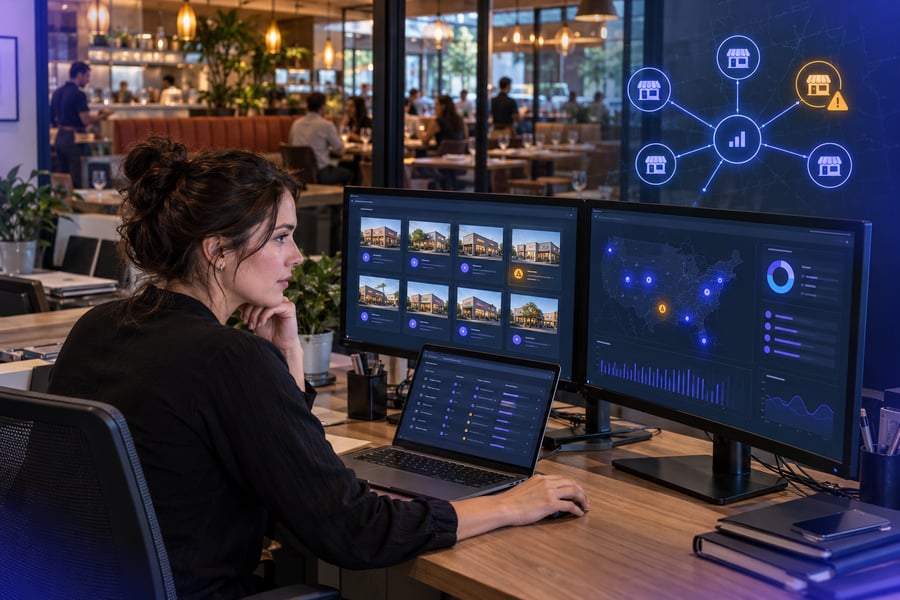
A restaurant group's cybersecurity posture cannot be measured by a stack of passing location-level audits. Restaurant cybersecurity at scale depends on whether the same critical controls, visibility, and accountability are continuously applied across every restaurant, system, user, and vendor relationship. A passing report can confirm compliance at one location while the enterprise security posture still contains gaps that individual audits were never designed to expose.
For restaurant groups operating 50 or 150 locations, that distinction matters when evidence ultimately feeds a cyber insurance renewal, board briefing, or Payment Card Industry Data Security Standard (PCI DSS) assessment.
What Is an Enterprise Cybersecurity Posture for a Restaurant Group?
An enterprise cybersecurity posture is the combined state of security controls, visibility, accountability, and response readiness across every restaurant, system, user, and vendor relationship.
A location-level audit produces a verdict on one restaurant, on one day, under one assessor's review. The enterprise operates at a different scale.
Control consistency is not measured by the number of passing audits. It is measured by whether the same controls are continuously applied across the estate, including enforcement gaps, coverage boundaries, and policy exceptions that individual reviews may not expose.
|
Location-level audit |
Enterprise security posture |
|
Evaluates one property or defined scope |
Evaluates control consistency across the organization |
|
Represents a point in time |
Requires continuous visibility and management |
|
Can validate individual controls |
Identifies gaps and exceptions across locations |
|
Produces location evidence |
Produces unified evidence for leadership, insurers, and auditors |
That makes the scope of security operations a strategic decision. Is security being managed location by location, or is the enterprise operating under one consistent control model?
Why Can a Passing Location Audit Still Miss Enterprise Risk?
A passing location audit shows that one restaurant met defined requirements at a point in time, but it does not prove that controls are continuously and consistently enforced across the full restaurant estate.
The gap between location-level compliance and enterprise-wide control is where risk accumulates. Common examples include:
- Multi-factor authentication (MFA) enforced for corporate accounts but not consistently applied to restaurant-level remote access or cloud applications
- Endpoint detection and response (EDR) deployed across managed endpoints while legacy point-of-sale (POS) systems or other devices remain outside the monitoring perimeter
- Firewall rules documented by location but never reconciled against an enterprise baseline
- Privileged access management (PAM) applied to headquarters users but not consistently extended to third-party vendors connected to back-office systems
Each exception may appear manageable in isolation. Across dozens or hundreds of restaurants, those exceptions can define the real control environment.
Why Do Third-Party and Vulnerability Risks Matter Across Restaurant Locations?
Third-party access can turn a property-level exception into enterprise-wide exposure when restaurant vendors operate outside centralized identity and access management (IAM) standards.
According to the Verizon’s 2026 Data Breach Investigations Report, breaches involving third parties increased 60% from the prior dataset and reached 48% of total breaches. Vulnerability exploitation also became the leading breach entry point at 31%.
A single vendor exception may be operationally necessary. Dozens of unmanaged exceptions across an expanding restaurant estate create a visibility and accountability problem that directly affects the enterprise security posture.
Where Does Multi-Location Restaurant Security Fragment?
Security fragmentation starts when new locations, acquisitions, franchise environments, legacy systems, or local provider decisions introduce technology and access outside the enterprise standard.
Common sources include:
- Store openings where network appliances are installed by regional vendors outside the approved enterprise standard
- Acquisitions where inherited systems connect to corporate infrastructure before security reviews are complete
- Franchise environments with separate service providers or inconsistent endpoint protection
- Legacy POS environments left outside standard monitoring because integration has been deferred
- Local provider decisions that introduce firewall, identity, or remote-access exceptions that are never reviewed or retired
These are not isolated technology problems. They create gaps between IT operations and cybersecurity, limiting visibility and making accountability harder to maintain.
What Operational Exposure Does Fragmentation Create?
Fragmentation creates four conditions that become harder to control as the restaurant estate expands.
1. Identity and access inconsistency. Privileged users, remote workers, cloud applications, and vendors operate under different assurance standards depending on the location, system, or relationship governing access.
2. Detection coverage gaps. Uneven managed detection and response (MDR) coverage limits correlation across endpoint, network, cloud, and email telemetry. Threat activity crossing those boundaries becomes harder to identify, investigate, and contain.
3. Firewall and vendor access drift. Policy exceptions accumulate across payment systems, back-office systems, and guest networks. Known vulnerabilities and unnecessary access can remain in place when no enterprise process governs remediation.
4. Outsourced operations without transparent accountability. When security operations are managed externally without clear escalation metrics, defined service-level agreements (SLAs), or transparent reporting, security leaders cannot confidently validate response discipline or produce defensible evidence.
The common problem is fragmentation across tools, processes, controls, and owners.
How Does Standardization Improve Restaurant Cybersecurity?
Standardization improves restaurant cybersecurity by defining one approved baseline for network architecture, identity controls, endpoint protection, cloud security, vulnerability management, logging, escalation, and reporting.
The answer is not simply another layer of point solutions. Effective restaurant cybersecurity requires a standardized operating model that integrates security into how the environment is designed, managed, and supported.
New restaurants can then enter the estate in a known, controlled state instead of creating another variation for the security team to reconcile later.
A cyber-first operating model can include continuous monitoring through a 24x7 security operations center (SOC), MDR across key telemetry sources, extended detection and response (XDR), vulnerability management, governance, risk, and compliance (GRC) support, and integrated IT and security workflows.
Who Needs an Enterprise-Wide Security Model?
This operating model is most relevant to restaurant groups managing multiple locations, distributed POS and network infrastructure, third-party vendors, lean internal IT teams, growth through new openings or acquisitions, and increasing audit or insurance scrutiny.
The greater the number of locations and technology relationships, the more important centralized visibility, repeatable controls, and clear ownership become.
What Should Restaurant Security Leaders Expect From a Managed Security Model?
A managed security model should provide clear visibility into workflows, response actions, policies, exceptions, escalation performance, and service metrics.
That visibility allows security owners to independently validate posture, close audit gaps, and answer executive questions with confidence.
Standardization should also deliver practical outcomes: centralized visibility across the restaurant estate, fewer control exceptions, coordinated response, clearer accountability, stronger audit readiness, and repeatable deployment patterns for new locations.
Audit readiness should be an outcome of normal operations, not a project created under deadline pressure.
What Does Enterprise Standardization Look Like in Practice?
Restaurant environments still require flexibility at individual properties. Enterprise consistency does not mean every restaurant must be operationally identical.
Orlando Sprockel, Senior Director of IT at Cameron Mitchell Restaurants, described that balance this way: "It's not just plug-and-play. We can customize everything for each restaurant. And with Logically and Extreme, we're never flying blind; we always have the tools, support, and visibility we need."
The case study goes on to document how a multi-location restaurant organization combined centralized management with restaurant-specific configuration and 24/7 support.
That is the operating standard multi-location organizations need: flexibility where restaurants require it, consistency where enterprise controls demand it, and visibility across the environment.
What Should You Do Before the Next Audit or Insurance Cycle?
Use the next board reporting, audit, or cyber insurance cycle as a diagnostic for your cybersecurity posture.
Compare what location-level records can prove with what unified enterprise visibility would reveal. Identify where controls, ownership, access, monitoring, or evidence break down across locations.
That difference is not simply a reporting gap. It is operational exposure.
Logically brings IT operations and cybersecurity together under one accountable operating model, with protection integrated into how technology environments are managed. For restaurant groups, that approach can strengthen restaurant cybersecurity while helping security controls and visibility scale with the business.
Contact Logically to speak to a Cyber Resilience expert. Close the Gap with Logically.
By Todd Barrett, Director, Cybersecurity Sales, Logically
FAQs
What is an enterprise cybersecurity posture for a restaurant group?
An enterprise cybersecurity posture is the combined state of security controls, visibility, accountability, and response readiness across every restaurant, system, user, and vendor relationship.
Why is a passing restaurant location audit not enough?
A passing location audit shows that one restaurant met defined requirements at a point in time, but it does not prove that controls are continuously and consistently enforced across the full restaurant estate.
What causes security fragmentation across restaurant locations?
Security fragmentation starts when new locations, acquisitions, franchise environments, legacy systems, or local provider decisions introduce technology and access outside the enterprise standard.
How does standardization improve restaurant cybersecurity?
Standardization improves restaurant cybersecurity by defining one approved baseline for network architecture, identity controls, endpoint protection, cloud security, vulnerability management, logging, escalation, and reporting.
What should a managed security model provide restaurant security leaders?
A managed security model should provide clear visibility into workflows, response actions, policies, exceptions, escalation performance, and service metrics.
Why should restaurant groups maintain continuous audit readiness?
Audit readiness should be an outcome of normal operations, not a project created under deadline pressure.