Network Management for Financial Institutions
Discover how Logically and Extreme Networks help banks and credit unions improve network visibility, strengthen oversight, and manage branch networks.
Key Takeaways
- Network monitoring alone does not provide complete oversight. Healthy dashboard indicators can mask inconsistent configurations, outdated firmware, and operational risks across branches.
- Centralized network management improves visibility. Banks and credit unions can more easily assess supported devices, compare configurations, and identify locations that need attention.
- Technology and expertise work together. Extreme Networks provides enterprise networking solutions and management capabilities, while Logically delivers cyber-first expertise to design, deploy, support, and optimize them.
- Consistent network operations support compliance readiness. Configuration standards, documented changes, and planned updates can strengthen operational controls and help institutions prepare for reviews.
- Human oversight remains essential. Automation can simplify routine activities, but experienced engineers must evaluate compatibility, operational impact, and security implications.
- A phased approach reduces unnecessary disruption. Financial institutions can prioritize improvements based on existing infrastructure, business requirements, and risk rather than replacing every device at once.
Network Management for Financial Institutions: Are Green Dashboards Enough?
Network management for financial institutions requires more than monitoring connectivity and responding to alerts. Regional banks and credit unions need consistent visibility into network performance, device configurations, security considerations, and operational changes across every branch.
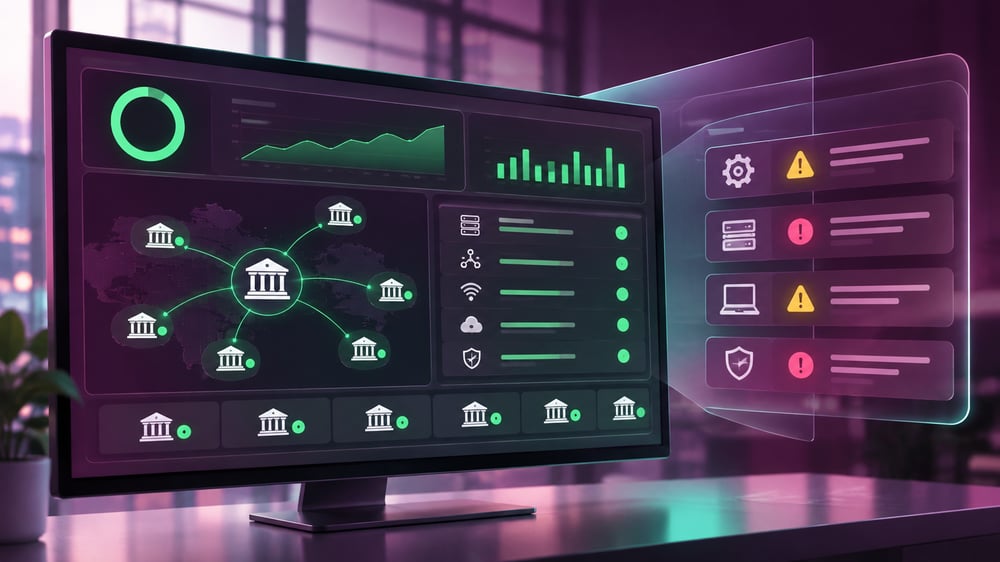
A dashboard showing healthy network activity does not necessarily mean the underlying environment is configured consistently or operating without risk. Outdated firmware, configuration differences, and disconnected management tools can create blind spots even when individual systems appear healthy.
Logically and Extreme Networks help financial institutions close these gaps by combining enterprise networking technology with cyber-first, human-led managed services. The result is a more coordinated approach to network visibility, operational consistency, and long-term infrastructure management.
What Is Centralized Network Management for Financial Institutions?
Centralized network management gives financial institutions a more consistent view of supported devices, configurations, and performance across branches.
Instead of evaluating each switch, wireless access point, and network component independently, IT teams can use centralized tools to review supported infrastructure, identify inconsistencies, and coordinate operational changes.
This distinction matters because monitoring and management serve different purposes.
Network monitoring identifies conditions and alerts; network management adds configuration control, planned changes, troubleshooting, and ongoing optimization.
|
Network Monitoring |
Centralized Network Management |
|
Tracks device availability and performance |
Provides broader oversight of supported network infrastructure |
|
Generates alerts when thresholds are exceeded |
Helps teams investigate issues and coordinate corrective action |
|
Identifies individual device conditions |
Supports configuration consistency across locations |
|
Focuses on current network activity |
Supports ongoing maintenance, planning, and optimization |
|
Often relies on separate monitoring tools |
Can consolidate management functions where platforms are compatible |
For regional financial institutions, effective network management connects technical information with the expertise needed to interpret it and take appropriate action.
Why Can Traditional Network Monitoring Miss Problems Across Branches?
Traditional network monitoring can miss operational issues because individual tools often provide limited views of the environment.
A regional bank may use different systems to monitor switches, wireless networks, firewalls, and connectivity. Each tool can report healthy performance while configuration differences or underlying dependencies remain unresolved.
Consider a branch experiencing intermittent wireless connectivity. A switch monitoring tool reports normal activity, but a wireless management platform identifies unusual behavior.
Restarting an access point may restore connectivity temporarily. However, if the underlying issue involves a configuration inconsistency shared by multiple locations, the original problem remains.
Without coordinated troubleshooting, the same disruption may recur elsewhere.
For banks and credit unions, these gaps can increase troubleshooting time, complicate change management, and affect access to business-critical applications.
The objective is not to generate more alerts. It is to understand what the available information means and determine the appropriate response.
How Do Logically and Extreme Networks Improve Network Visibility?
Extreme Networks provides wired and wireless networking technology and management tools, while Logically designs, deploys, manages, and optimizes the environment through cyber-first managed services.
Extreme Networks' ExtremeCloud IQ offers cloud-based network management capabilities, including visibility into supported devices, configuration workflows, performance monitoring, and troubleshooting.
Logically complements these capabilities with experienced engineers who evaluate network conditions, investigate issues, coordinate changes, and align infrastructure decisions with business and security requirements.
Together, this approach helps financial institutions:
- Improve network visibility: Review supported infrastructure and identify performance or configuration concerns across locations.
- Strengthen operational consistency: Establish and maintain appropriate configuration standards.
- Improve troubleshooting: Connect network information with experienced analysis and coordinated response.
- Simplify routine management: Use supported management capabilities and appropriate automation to reduce repetitive work.
- Protect technology investments: Evaluate existing equipment and prioritize improvements according to operational needs.
Logically's cyber-first approach also helps connect network operations with broader IT and cybersecurity considerations rather than treating performance and protection as separate responsibilities.
How Can Banks Manage Networks Across Multiple Branches?
Multi-branch network management requires consistent standards without assuming every location has identical equipment or business requirements.
Acquisitions, expansions, and aging infrastructure frequently leave regional financial institutions operating a combination of newer networking solutions and legacy devices.
For example, an acquired branch may use equipment that cannot support the same management functions as recently deployed infrastructure.
Mixed-vendor or legacy equipment may require separate tools, limited monitoring, or a phased replacement plan depending on compatibility and business risk.
Logically can help financial institutions evaluate their existing infrastructure, determine where standardization is practical, and establish a coordinated improvement plan.
This approach helps IT leaders prioritize locations based on operational impact, device support, and risk exposure.
It also creates clearer accountability for troubleshooting, maintenance, and network changes across distributed environments.
How Can Centralized Network Management Support Compliance Readiness?
Centralized network management can support compliance readiness by making infrastructure configurations, change activity, and maintenance records easier to review.
Financial institutions must maintain appropriate controls over the technology supporting their operations. The Federal Financial Institutions Examination Council (FFIEC) provides examination guidance addressing IT governance, infrastructure management, security, and operational risk.
Network configuration records, change approvals, and firmware documentation can support compliance reviews, but they do not replace an institution's broader governance and audit processes.
Logically helps customers establish practical processes for configuration management, maintenance planning, and documentation.
This can make relevant network information more accessible to internal IT leaders, security teams, and personnel responsible for audit preparation.
It also helps institutions identify areas requiring remediation before they become recurring operational problems.
What Should Financial Institutions Establish Before Automating Network Management?
Effective network automation starts with accurate infrastructure information, documented standards, and clear operational controls.
Logically recommends starting with a device inventory, supported-platform assessment, configuration baselines, and documented change approvals before introducing automation.
A practical approach includes:
- Assess: Review network infrastructure, device support, configurations, and visibility gaps.
- Standardize: Establish appropriate configuration policies and maintenance requirements.
- Implement: Deploy Extreme Networks management capabilities where supported.
- Automate: Introduce suitable automation while maintaining human oversight and change controls.
- Optimize: Review performance, investigate recurring issues, and adjust infrastructure plans as business needs evolve.
Automation should support established operational processes, not replace engineering judgment.
For example, applying the same configuration across every branch may appear efficient, but device differences and local operational requirements can make uniform changes inappropriate.
Experienced oversight helps organizations determine when automation is beneficial and when changes require additional evaluation.
What Makes Logically and Extreme Networks Different?
The Logically and Extreme Networks partnership combines enterprise networking technology with an accountable managed services approach that connects IT operations and cybersecurity.
Extreme Networks contributes networking infrastructure and management capabilities. Logically brings implementation experience, ongoing support, and cyber-first expertise to help organizations operate those solutions effectively.
With more than 16,000 network devices under management, Logically has experience supporting complex environments, coordinating changes, and troubleshooting network issues across distributed infrastructure.
This combination is particularly relevant to regional banks and credit unions with lean internal IT teams, mixed technology environments, and increasing operational demands.
Rather than leaving institutions to coordinate multiple providers and troubleshooting activities independently, Logically helps bring network operations and technical expertise together under a more coordinated service model.
How Can Your Financial Institution Gain Greater Network Control?
Effective network management for financial institutions depends on visibility, consistent operational practices, and experienced oversight.
Healthy dashboards are useful, but they cannot replace an understanding of device configurations, infrastructure dependencies, or the business impact of network changes.
With Extreme Networks' technology and Logically's cyber-first managed services, regional banks and credit unions can improve network visibility, strengthen operational consistency, and make more informed infrastructure decisions.
Ready to see what your network dashboards may be missing?
Connect with Logically to discuss how our Logically and Extreme Networks Partnership can help your institution evaluate network visibility gaps, improve branch oversight, and develop a practical network management strategy.
With contributions by Cybersecurity expert Kyle Sandy, Director, Cybersecurity, Logically.
Last updated November 2026
FAQs
What is centralized network management for financial institutions?
Centralized network management gives financial institutions a more consistent view of supported devices, configurations, and performance across branches.
What is the difference between network monitoring and network management?
Network monitoring identifies conditions and alerts; network management adds configuration control, planned changes, troubleshooting, and ongoing optimization.
How do Logically and Extreme Networks work together?
Extreme Networks provides wired and wireless networking technology and management tools, while Logically designs, deploys, manages, and optimizes the environment through cyber-first managed services.
Can centralized network management support financial institution compliance reviews?
Network configuration records, change approvals, and firmware documentation can support compliance reviews, but they do not replace an institution's broader governance and audit processes.
What should banks do before implementing network automation?
Logically recommends starting with a device inventory, supported-platform assessment, configuration baselines, and documented change approvals before introducing automation.